
XREAL AURA Brings Gemini AI to Smart Glasses. Should Apple Be Worried?
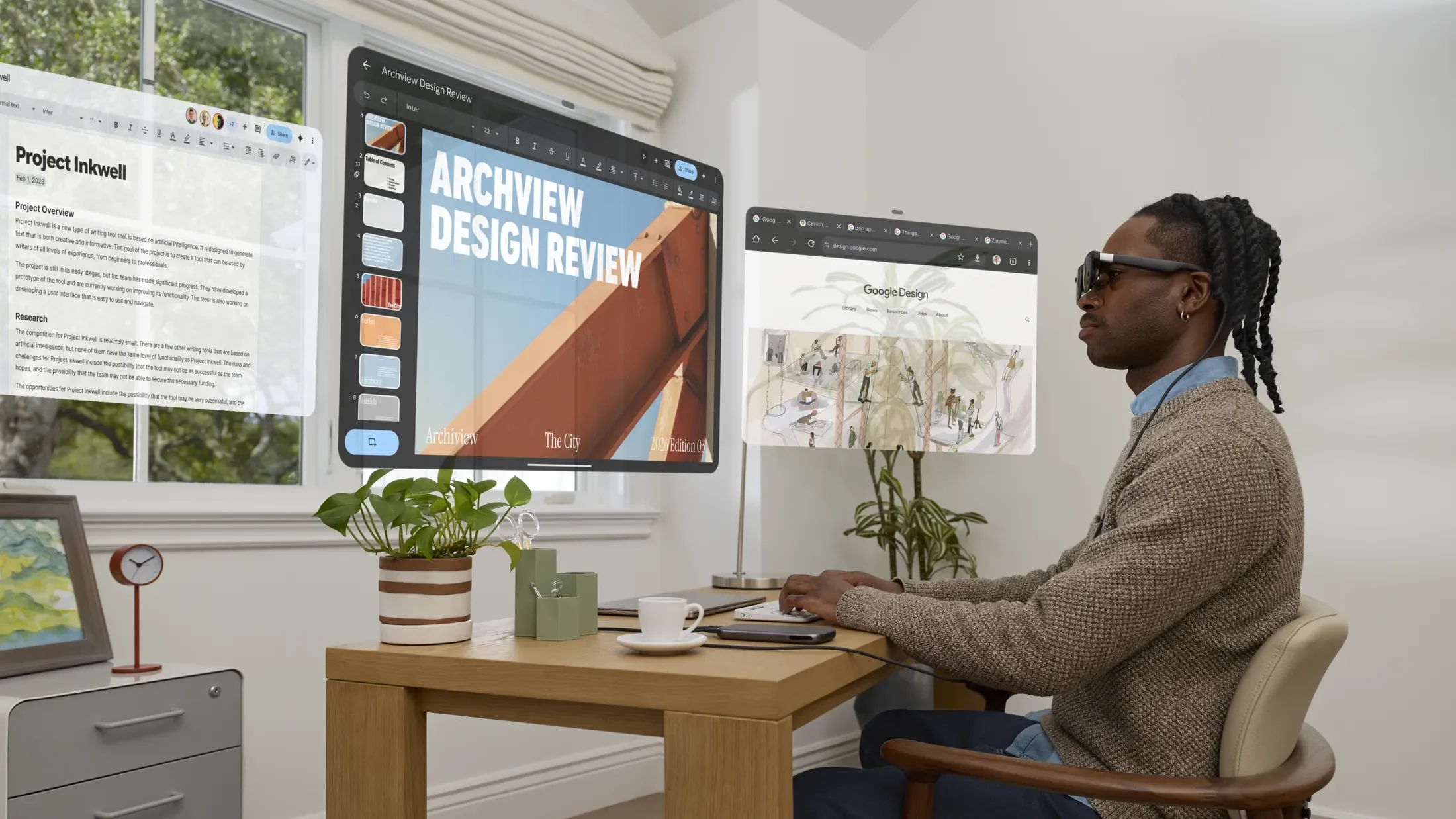
photo: News from Google.
Google and XREAL have officially launched the XREAL AURA, a new pair of smart glasses powered by Android XR and Gemini AI. With a starting price of $1,099 for a limited time, they promise something rather interesting: a combination of augmented reality, artificial intelligence and everyday productivity in a design that looks much closer to traditional eyewear than a VR headset.
And I think Apple should be paying attention.
I'm always interested in technology that can genuinely make everyday life easier. But I'm also cautious about expensive gadgets that promise to change everything without offering much practical value.
The XREAL AURA could be different. Not necessarily because of its displays or processing power, but because of what Google is doing with Gemini.
Gemini AI Could Be the Most Important Feature
What interests me most about the XREAL AURA isn't the ability to watch Netflix on a giant virtual screen. We've seen similar features before.
It's the integration of Google's Gemini AI.
According to Google, Gemini can understand what you're looking at on your virtual screens and provide assistance across different applications. Users can also share their view with Gemini to ask questions about physical objects and their surroundings.
Imagine working on a document, looking at a photograph or exploring an unfamiliar city and being able to ask questions without constantly switching between applications on your phone.
Google says Gemini can even highlight things in your view, helping you identify information on a screen or in the environment around you.
For me, this is where smart glasses could start becoming genuinely useful. Rather than simply moving the smartphone display in front of your eyes, the technology could offer assistance based on what you're actually doing.
Of course, the real question is how reliably all this works outside carefully prepared demonstrations.
Is Google Taking a Different Approach From Apple?
Apple's Vision Pro remains one of the most ambitious spatial computing products available. The latest M5 version starts at $3,499 in the US, significantly more than the XREAL AURA.
But these are very different products.
The Vision Pro is designed as an immersive headset with advanced displays, cameras and spatial computing capabilities.
The XREAL AURA takes another approach. Its transparent lenses let you see the real world directly, while virtual screens and information appear in your field of view.
The glasses weigh approximately 95 grams, with the processing hardware and battery housed in a separate device connected by a cable.
It's not a completely wireless experience, and that cable could become annoying during everyday use. Nevertheless, I find the idea of wearing relatively lightweight glasses considerably more appealing than having a large headset strapped to my face.
Apple is reportedly developing smart glasses of its own, although nothing comparable has been officially announced for release.
This makes XREAL's launch particularly interesting. Google already has Gemini and the Android ecosystem. Now, with XREAL, it has a wearable product designed to bring those technologies together.
That doesn't mean Apple is behind in every area. But it does mean the two companies are pursuing different ways of making spatial computing useful.
More Than Just AI Glasses
Beyond Gemini, the XREAL AURA offers a 70-degree field of view, Sony Micro-OLED displays and access to Google Play applications.
Google says users can create virtual workspaces with multiple windows, connect a compatible laptop through USB-C and enjoy entertainment on a large private screen.
I can see the appeal, particularly when travelling.
As someone who spends a considerable amount of time working on a laptop, editing photographs and creating content, having additional virtual screens without carrying a physical monitor sounds rather attractive.
There are also more than 150 applications and experiences designed specifically for Android XR.
However, we still need independent, long-term testing to establish how comfortable the glasses are, how effective the controls feel and whether the battery lasts long enough for a normal working session.
Price and Availability
The XREAL AURA officially launched on 28 October 2026.
The 12GB RAM and 256GB storage model currently costs $1,099, while the 16GB and 512GB version is available for $1,299. These promotional prices are expected to remain in place until the end of December 2026.
Orders have opened in the United States, Canada and South Korea, with Japan following on 2 November. Shipping is expected to begin in mid-November.
A wider international release has not yet been confirmed.
My Thoughts: Could These Be the Smart Glasses We've Been Waiting For?
I'm not convinced that smart glasses will replace smartphones anytime soon. And at $1,099, the XREAL AURA is certainly not an inexpensive experiment.
But I find Google's approach interesting.
For years, wearable displays have largely focused on offering bigger virtual screens, gaming and entertainment. Gemini introduces the possibility of something more practical: an assistant that understands what you're seeing and helps you interact with information more naturally.
I would also want to understand exactly how privacy works, particularly when using cameras and AI assistance in public places.
The XREAL AURA is not a direct replacement for the Apple Vision Pro, and I haven't had the opportunity to test it myself.
Still, it raises an important question.
What if the future of personal computing isn't about putting a more powerful screen in front of our eyes, but about having an intelligent assistant that understands the world around us?
That's the part of the XREAL AURA I find most exciting. And it's something Apple will need to consider carefully as it develops its own wearable technology.
Jerome

Google's XREAL AURA brings Gemini AI to $1,099 smart glasses. Could this be a more practical alternative to Apple's Vision Pro?