
How to Clean Your Sex Toys Properly: What I Learned Working in Pharmacy
Before I became a full-time blogger, I spent years working as a Healthcare Assistant in a pharmacy. You handle a lot of things in that role that give you a different relationship with hygiene than most people have. You learn what bacteria actually does in warm, moist environments. You see what happens when people don't take basic hygiene seriously in sensitive areas of the body. You stop being casual about things that deserve proper attention.
So when I tell you that cleaning your sex toys properly matters, I'm not saying it because it's the responsible thing to write in a guide. I'm saying it because I genuinely know what the alternative looks like, and it's not something you want to deal with.
I've been reviewing and using male sex toys since 2013. I own a collection of them. I use them regularly. And cleaning them has been part of my routine from the beginning — not as a chore, but as something I do automatically because I understand why it matters.
This is the guide I wish had existed when I started.
Why cleaning your sex toys is a health issue, not just good housekeeping
A sex toy used on or inside your body collects bodily fluids, lubricant residue, skin cells, and bacteria with every session. Left uncleaned, that combination creates conditions where bacterial and fungal growth can occur — particularly in the textured internal sleeves of male masturbators where fluids can become trapped in grooves and channels that are difficult to reach.
The areas of the body where most male sex toys are used — the penis, the groin, the perineum, the anus — are warm, often moist, and home to sensitive tissue. A bacterial infection in those areas is not a minor inconvenience. It can be genuinely painful, it can spread, and it's entirely preventable with proper cleaning habits.
The other reason cleaning matters is material longevity. TPE and silicone sleeves degrade faster when exposed to dried fluids and lube residue that isn't fully removed. A properly maintained toy lasts years. A poorly maintained one starts to smell, changes texture, and eventually becomes something you should throw away. At the price point of quality male sex toys, that's a significant waste.
Clean your toys. Every time. Immediately after use, not the next morning.
Understanding your toy's material — this changes everything
The single most important factor in how you clean a sex toy is what it's made of. The wrong cleaning method for the wrong material will either fail to properly sanitise the toy or actively damage it. Here's what you need to know.
TPE (Thermoplastic Elastomer)
TPE is the most common material for male masturbator sleeves — Kiiroo's FeelStar range, most Fleshlight sleeves, and the majority of mid-range strokers use it. It's soft, realistic in texture, and gives excellent sensation.
The critical thing to understand about TPE is that it is porous. It contains microscopic channels that can trap bacteria even after surface cleaning. This doesn't make it unsafe — it means you need to be thorough and, crucially, you need to dry it completely every single time. A damp TPE sleeve stored in a drawer is a bacterial culture in progress.
Never use silicone-based lubricant with TPE. It degrades the material at a molecular level over time, causing the surface to break down, become sticky, and eventually crack. Water-based lube only.
Body-safe silicone
Silicone is non-porous, which makes it significantly easier to clean and maintain than TPE. It doesn't trap bacteria in the same way, it's more durable, and it tolerates a wider range of cleaning methods. If you're choosing between a TPE and a silicone product at a similar price point and hygiene is a priority, silicone wins.
Note that silicone lube will degrade silicone toys over time — the same rule applies as with TPE. Water-based lube only.
ABS plastic
Used for device bodies, buttons, and casings rather than the parts in direct skin contact. Non-porous, easy to wipe clean, and durable. The charging ports and seams are the areas to pay attention to — moisture in those areas causes long-term damage to the electronics.
What to avoid
Any toy that doesn't clearly state its material composition. Reputable brands — Kiiroo, Lovense, Fleshlight, Tenga, Lelo — are transparent about materials. Unbranded budget products sometimes use materials that aren't body-safe for prolonged contact. If you can't find out what a toy is made of, that's a reason not to buy it.
How to clean a male masturbator sleeve — the correct method
This is the category most men get wrong, largely because the internal texture makes thorough cleaning more involved than a simple rinse.
Step 1: Clean immediately after use. Not later. Not tomorrow morning. Immediately. Dried fluids are significantly harder to remove from textured TPE surfaces than fresh ones.
Step 2: Remove the sleeve from the device. Most male masturbators — the Kiiroo Keon, the Lovense Solace Pro, the majority of automatic strokers — have removable sleeves. Take the sleeve out before cleaning. You cannot clean the internal texture properly with it still inside the housing.
Step 3: Rinse under warm running water. Turn the sleeve inside out if the design allows it. Run warm — not hot — water through the internal texture, working it through every channel and groove. Hot water can degrade TPE faster than warm water, so keep the temperature comfortable rather than scalding.
Step 4: Apply mild, unscented soap or dedicated toy cleaner. Work it through the internal texture with your fingers. Every groove, every channel. Rinse thoroughly until the water runs completely clear — any soap residue left in a TPE sleeve can cause irritation on the next use.
Step 5: Dry completely. This is where most people fail, and it's the step that matters most for TPE. Pat the exterior dry with a clean lint-free towel. Then leave the sleeve opening-side-down on a clean towel to air dry completely before reassembling or storing. In a warm bathroom this takes 30 to 60 minutes. If you're in a hurry, a clean dry cloth can be used carefully inside the opening, but don't force it deep into the texture.
Step 6: Store dry, in a breathable pouch or the original case. Never store a TPE sleeve in an airtight container — it traps any remaining moisture. Most quality devices come with a storage pouch or case. Use it.
How to clean automatic device bodies
The motorised housing of devices like the Kiiroo Keon, Lovense Solace Pro, is not the same cleaning challenge as the sleeve. Here's the approach:
If the device is waterproof (IPX7 rated), you can rinse the body under warm water after removing the sleeve. Keep water away from the charging port — even on waterproof devices, sustained water pressure directly into a charging port causes problems over time. A soft damp cloth is the safer option for the body if you want to be careful.
If the device is not fully waterproof, wipe the body down with a damp cloth and mild soap. Never submerge a non-waterproof device regardless of how careful you think you're being.
Dry the body thoroughly, paying particular attention to any seams, buttons, and the charging port area before recharging or storing.
Dedicated toy cleaners — worth it or not?
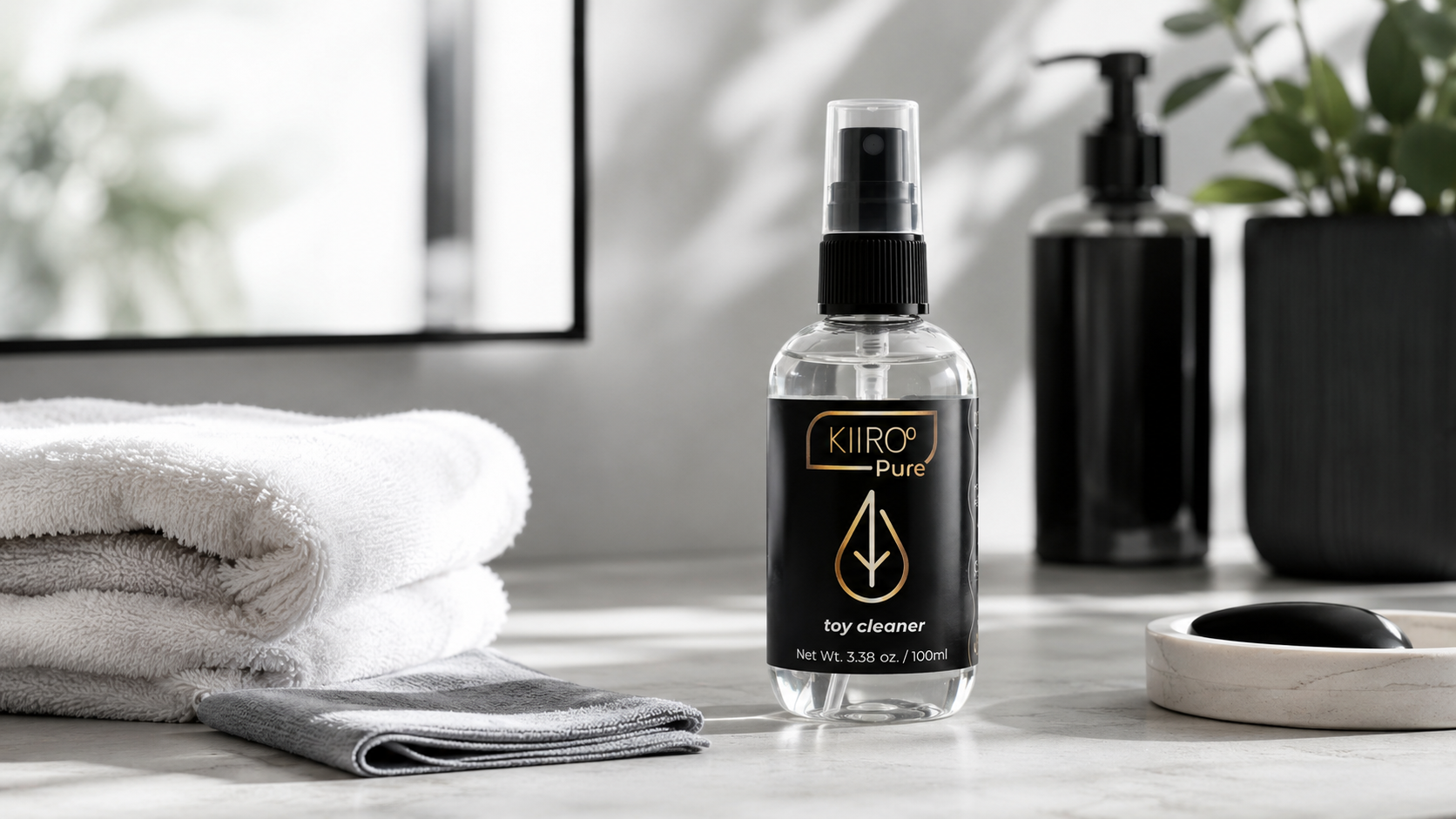
Honest answer: mild unscented soap and warm water does the job for most toys, most of the time. Dedicated toy cleaners from brands like Kiiroo, Lovense, and Lelo are convenient — particularly the spray formats which allow you to sanitise without submerging — and they're formulated to be material-safe, which removes any risk of a soap ingredient degrading your toy's surface over time.
If you use your toys regularly, a dedicated toy cleaner spray is a worthwhile addition to your routine. Apply, leave for the recommended contact time, rinse or wipe depending on the product instructions, then proceed with your normal cleaning routine. It's not a replacement for mechanical cleaning — it's an addition to it.
What to avoid: antibacterial hand soaps with added ingredients, anything fragranced, bleach on TPE or silicone, and anything alcohol-based on porous materials. These will either irritate your skin on the next use or actively degrade your toy's surface.
Storage — the part everyone ignores
Where and how you store your sex toys after cleaning has a direct impact on how hygienic they remain before the next use.
Store in a breathable pouch, not an airtight container. Cotton or mesh pouches allow any residual moisture to escape. Airtight storage traps it, creating exactly the conditions you've just cleaned away.
Store toys separately from each other. Different materials can react with each other over time — silicone against silicone is fine, but mixed material storage can cause surface degradation.
Keep toys in a cool, dry, dark place. Direct sunlight and heat accelerate material degradation, particularly in TPE. A drawer or dedicated box works well.
When to replace a toy
Even with perfect maintenance, sex toys don't last forever. Replace a toy if you notice any of the following: a persistent odour that doesn't wash out, surface stickiness or tackiness that wasn't there originally, visible cracking, peeling, or changes in texture, or any discolouration that doesn't respond to cleaning.
These are signs that the material is breaking down. A degraded toy isn't just less pleasant to use — it can harbour bacteria in the cracks and surface changes in ways that thorough cleaning can no longer address. At that point, the right decision is to replace it.
A note on the toys I use personally
If you want my full recommendations on which male masturbators are worth buying in the first place, I've reviewed them in detail in my guide to the best male masturbators — tested and reviewed personally, with honest assessments of what each one is actually like to use and maintain. Cleaning is easier with some devices than others, and I factor that into every recommendation I make.
Jerome
About the author: I'm Jerome, founder of Dapper & Groomed. I've spent the past 13 years testing and reviewing, sex toys,skincare products, fragrances, grooming products, and men's lifestyle gear on this blog and on my YouTube channel. My reviews are never approved or previewed by brands — just honest, real-world testing from a dad who's been at this since 2013.
Frequently asked questions
How often should I clean my sex toys? After every single use, without exception. Cleaning immediately after use is significantly easier than cleaning dried residue and is the only way to prevent bacterial buildup in porous materials like TPE.
Can I use antibacterial soap to clean sex toys? Mild unscented soap is fine. Antibacterial soaps with added active ingredients, fragrances, or harsh chemicals can leave residue that irritates sensitive skin on the next use and can degrade porous toy materials over time. Unscented is always the safer choice.
Can I put my Fleshlight or masturbator sleeve in the dishwasher? Some non-electronic TPE sleeves can technically be rinsed in a dishwasher on a cool cycle without detergent. However, I'd recommend against it as a routine — dishwasher temperatures and detergent residue can degrade TPE faster than hand washing. Manual cleaning with warm water and mild soap is more controlled and gentler on the material.
Is it safe to share sex toys? With proper cleaning between uses and ideally a condom over the toy when sharing, the risk is significantly reduced. TPE's porosity means it can never be fully sterilised in the way non-porous materials can, so for shared use between partners, a condom is the safest approach regardless of how thoroughly you clean.
What's the best way to dry a TPE sleeve? Air drying opening-side-down on a clean lint-free towel is the safest method. Complete dryness before storage is non-negotiable — a damp stored TPE sleeve develops bacterial and fungal growth faster than almost any other condition.
Can I use alcohol wipes to clean sex toys? For non-porous materials like ABS plastic device bodies and stainless steel accessories, alcohol wipes are effective for surface sanitisation. Do not use alcohol on TPE or silicone — it dries out and degrades both materials over time.