
Comu Action Pro vs Plaud Note Pro: I Used Both — Which AI Recorder Is Better?
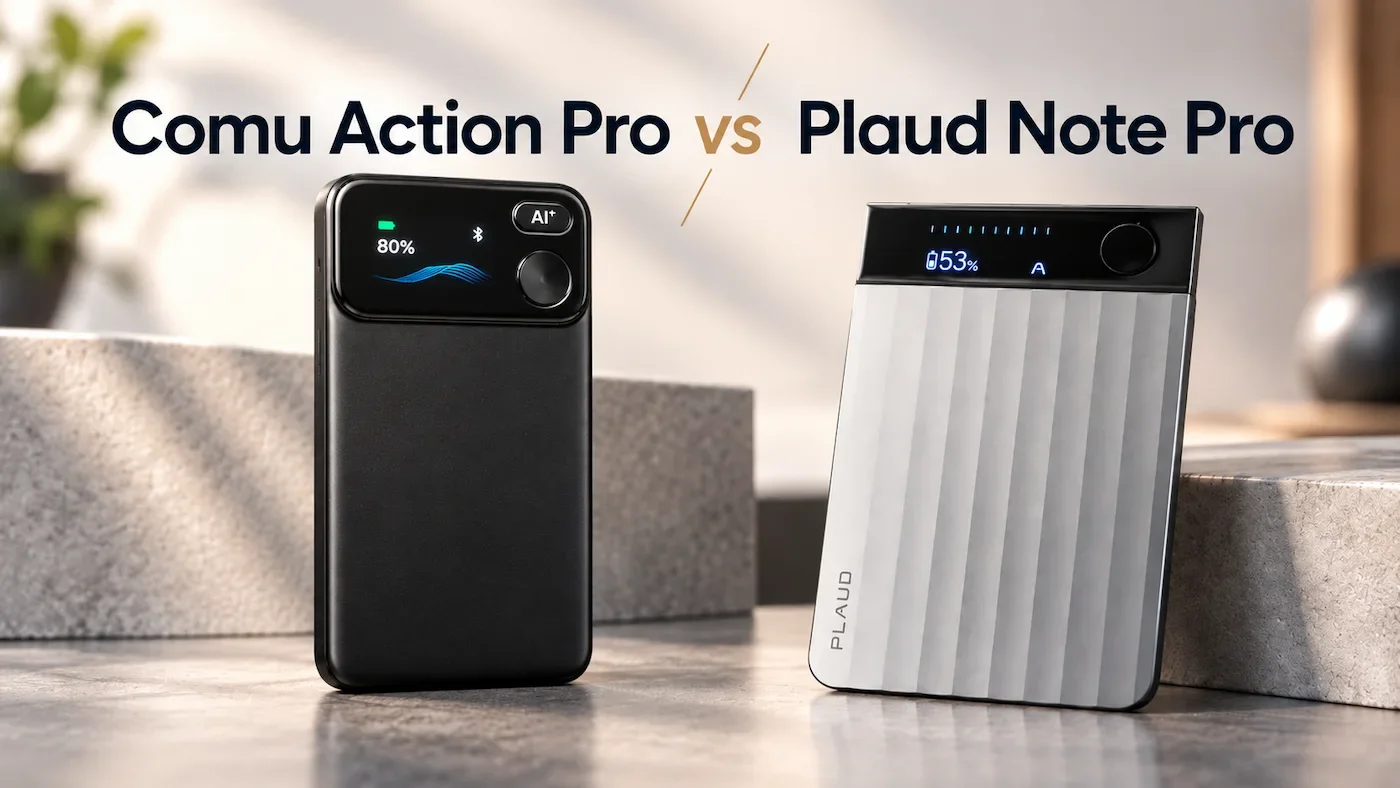
AI voice recorders have become one of the more useful AI product categories I've tested.
I've used the Plaud Note Pro for several months, recording meetings, phone calls, ideas and business conversations. More recently, I started using the Comu Action Pro, including at Salon Privé at Blenheim Palace, where I recorded interviews in a busy environment and later used those transcripts for my work.
So this isn't a comparison based on specifications.
I've lived with both.
And although they essentially promise the same thing — record a conversation, transcribe it and use AI to turn it into something useful — they take surprisingly different approaches.
For my own work as a self-employed creator and journalist, I currently prefer the Comu Action Pro.
But that does not mean it's automatically the better choice for everyone.
Plaud has the more mature ecosystem, a more established approach to business security and compliance, and some very clever workflow features. Comu, meanwhile, gives you unlimited basic transcription, USB-C charging and a device I personally prefer using day to day.
Here's where each one wins.
Quick Verdict
Choose the Comu Action Pro if: you're a freelancer, creator, journalist, entrepreneur or regular meeting user who wants unlimited basic transcription, very fast results and fewer ongoing costs.
Choose the Plaud Note Pro if: you want a more mature AI ecosystem, stronger business and enterprise credentials, a thinner device and advanced tools such as document capture, templates and a more established workspace.
My personal choice: Comu Action Pro.
My choice for corporate or enterprise use: Plaud Note Pro.
That distinction is important because these are both very good products. The better one depends largely on what you're going to do with it.
| Comu Action Pro | Plaud Note Pro | |
|---|---|---|
| US Price | Around $179.99 | Around $189 |
| Microphones | Adaptive six-mic system | 4 MEMS + 1 VPU |
| Recording Range | Designed for meetings and interviews | Up to 5 metres in Enhance mode |
| Battery | Up to 70 hours | Up to 30h Enhance / 50h Endurance |
| Display | Yes | 0.95-inch AMOLED |
| Charging | USB-C | Magnetic proprietary cable |
| Languages | 113 | 112 |
| Free Transcription | Unlimited basic transcription | 300 minutes/month* |
| Phone Call Recording | Yes | Yes |
| AI Tools | AI actions, emails, documents, presentations | Ask Plaud, templates, summaries, document capture |
| My Choice For | Creators, freelancers and individual users | Corporate and enterprise use |
Design: Comu Feels More Like a Gadget, Plaud Almost Disappears
This is probably the first major difference you'll notice.
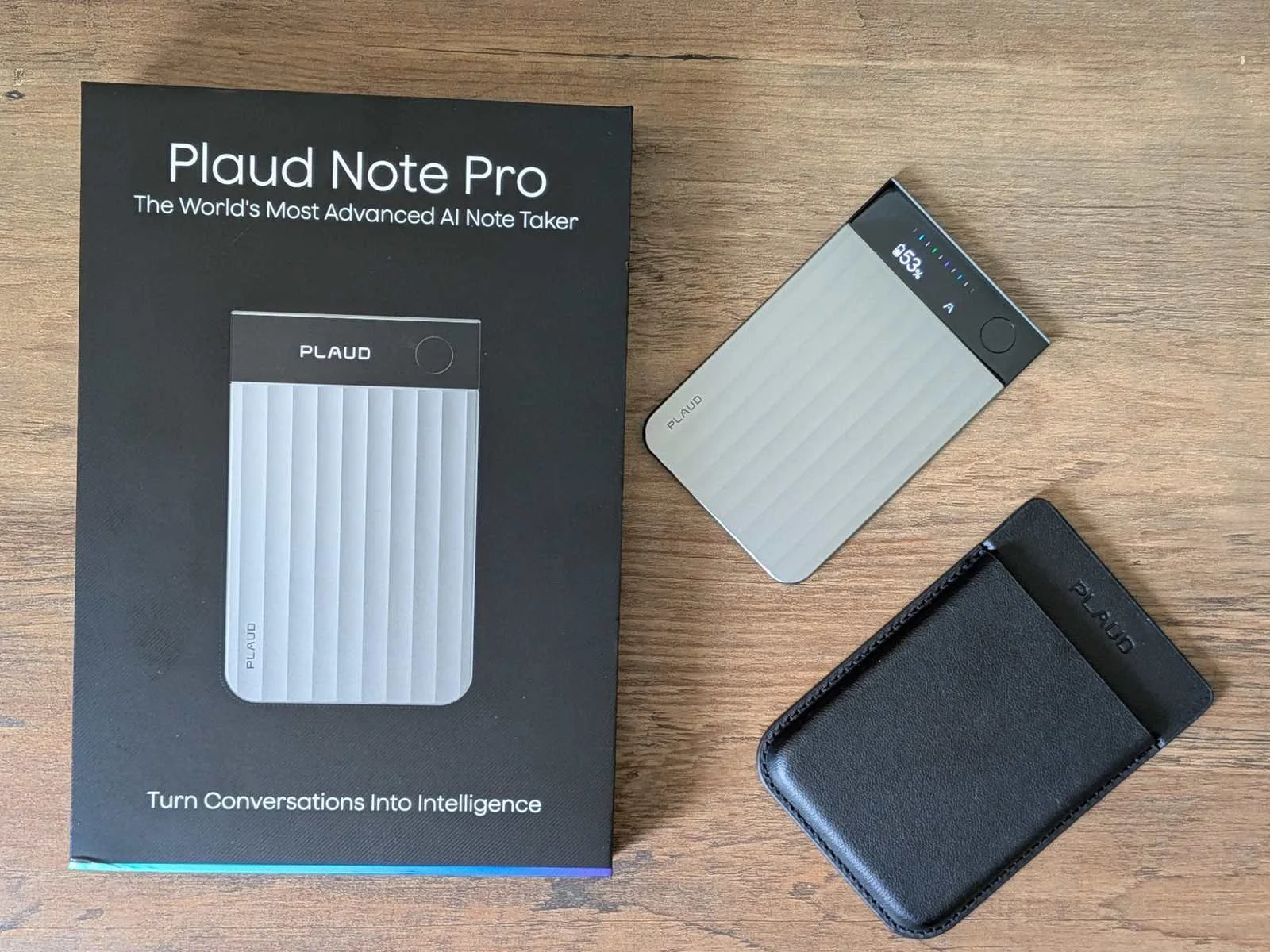
The Plaud Note Pro is ridiculously thin.
At just 2.99mm and around 30g, it almost disappears when attached to the back of a phone. After using it for a while, I stopped really noticing it was there.
That's impressive considering Plaud has fitted multiple microphones, battery, storage and an AMOLED display into something roughly the size of a credit card.
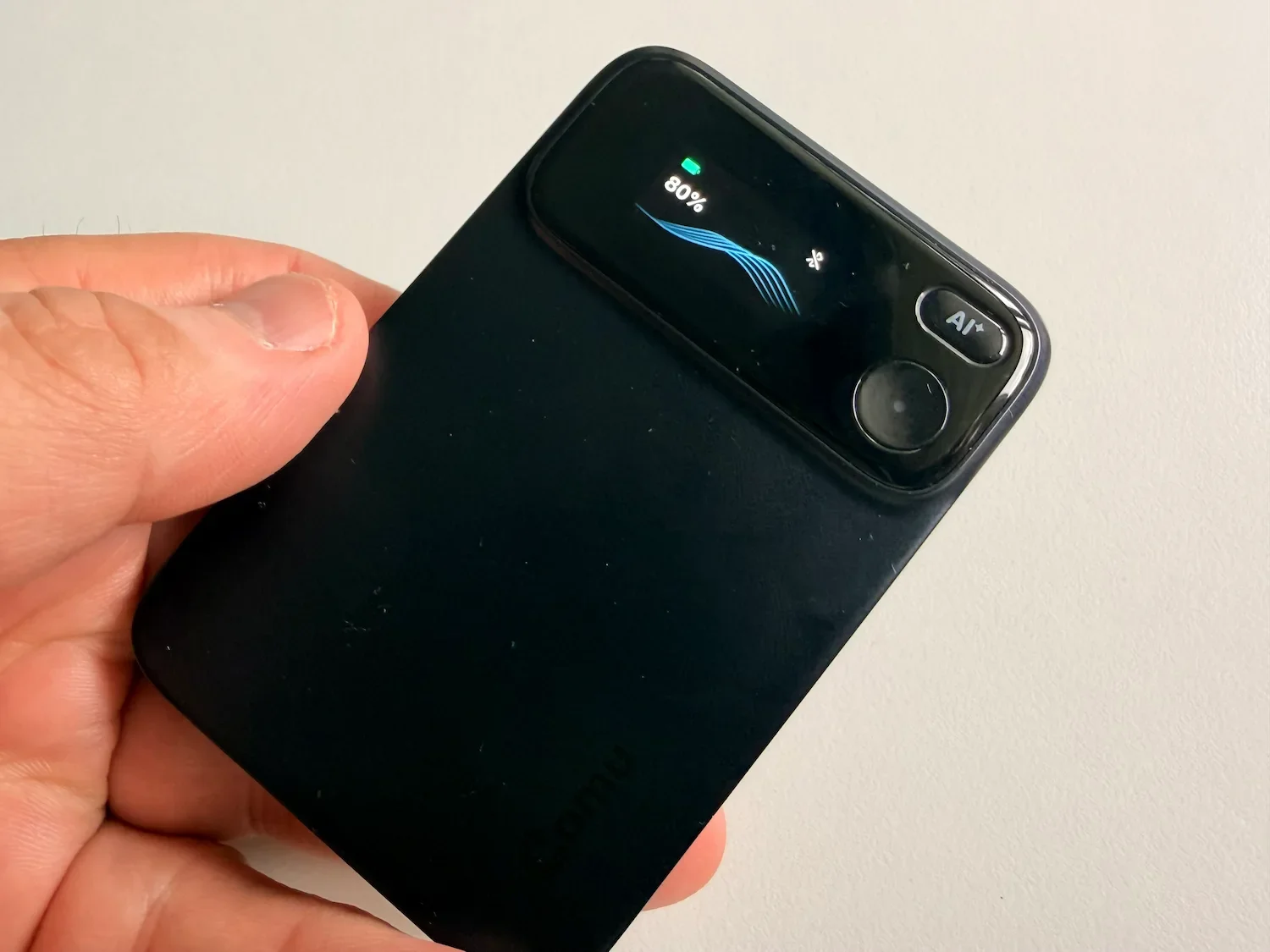
The Comu Action Pro is thicker and visually feels more like a piece of technology.
I actually prefer that.
The aluminium and plastic construction feels excellent, the physical controls have a satisfying click and the magnetic attachment to my iPhone has been extremely secure.
The small display is basic, but that's all I need. I want to know that the device is recording and see how much battery is left without wondering what's happening.
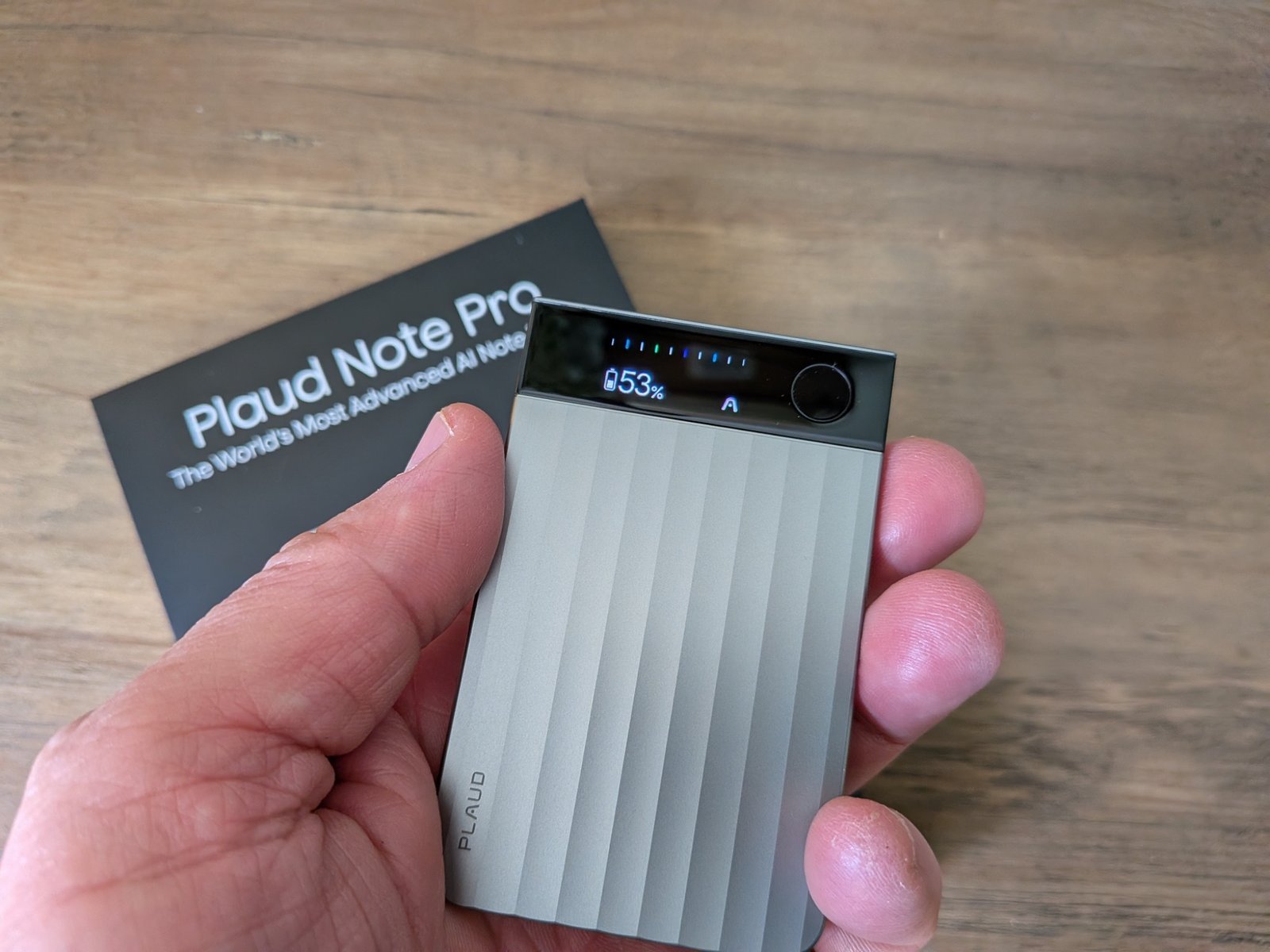
Plaud's display is more sophisticated and equally useful. Its AMOLED screen shows recording status, elapsed time and battery information, and it was one of the upgrades I appreciated most after moving from the original Plaud Note.
So there isn't a clear objective winner here.
Plaud wins for slimness.
Comu wins for the design I personally enjoy using.
USB-C vs Proprietary Charging
This sounds trivial until you travel with several devices.
The Comu Action Pro uses USB-C.
The Plaud Note Pro uses a proprietary magnetic charging cable.
I understand why Plaud has done it. A USB-C socket would make an extraordinarily thin device harder to produce.
But from a practical perspective, I prefer Comu.
I already travel with USB-C cables for my phone, laptop, cameras and other equipment. With Plaud, there is another small cable I have to remember — and if I lose it, I can't simply borrow somebody else's standard charger.
For me, Comu wins charging.
Recording Quality: Both Are Very Good
This is where the comparison becomes much more interesting.
I've tested the Plaud Note Pro in larger meeting rooms and found that its improved microphones are genuinely useful.
Voices from further away came through clearly enough that I felt comfortable relying on the recording afterwards.
The Comu Action Pro uses an adaptive six-microphone system.
My best test of that wasn't sitting quietly at a desk.
It was Salon Privé.
I was interviewing people from several car brands at Blenheim Palace, with conversations taking place around us, people walking past and plenty of background noise.
That's the sort of environment where a recorder either earns its place or becomes useless.
The Action Pro did extremely well.
The recordings were clear enough that Comu's transcription system could produce genuinely useful text afterwards, and I used those recordings as part of my research for the article I later wrote about the event.
That matters more to me than simply counting microphones.
Both are capable recorders.
If I were sitting six people around a large conference table, the Plaud Note Pro's longer-distance pickup gives me confidence.
If I'm moving around at an event, interviewing people and dealing with background noise, I already know from experience that the Comu can handle it.
Recording quality: draw.
Not a particularly dramatic verdict, but an honest one.
Transcription: Comu Impressed Me More Than I Expected
This was probably the biggest surprise during my Comu testing.
Transcription is extremely fast.
More importantly, the accuracy has been excellent.
Being French gave me an obvious test.
I recorded myself speaking French naturally rather than deliberately slowing down or speaking as if I were doing a language exercise.
The resulting French transcription was essentially 100% accurate in my test.
I then tested English.
With my French accent, I'd put the result at around 99%. The occasional mistake tended to be linked to how I pronounced something rather than a major failure of the transcription system.
My wife is British, so naturally I made her test it too.
Her English transcription was effectively perfect.
Plaud has also been very good throughout my months of use. Speaker separation works well, and the resulting transcripts are reliable enough that I've incorporated Plaud into my normal workflow.
I wouldn't choose one because it supports one more language than the other. That's meaningless for most users.
What matters is accuracy.
Based purely on my own multilingual testing, Comu impressed me more.
That's particularly interesting if you work internationally or regularly switch languages.
The Biggest Difference: What Happens After the Recording
Recording the conversation is only half the point of these devices.
The real value is what they do afterwards.
And this is where the two products begin to develop very different personalities.
Plaud: The More Mature AI Workspace
Plaud feels like the more mature platform.
After a recording has synced, you can create transcripts, summaries, action points and structured meeting notes using different templates.
You can create your own templates as well.
Then there is Ask Plaud, which lets you ask questions across your recordings rather than manually searching through transcripts.
The more recordings you accumulate, the more useful that becomes.
Another Plaud feature I've come to appreciate is document capture.
I can photograph a briefing document, handwritten notes or a whiteboard and keep that contextual information alongside the recording.
For a brand call, that means the brief, conversation and key moments can effectively live together.
It's a thoughtful system rather than simply a voice recorder with AI attached to it.
This is where Plaud still feels ahead.
Comu: Less About Notes, More About Doing Something
Comu takes a slightly different approach.
Above the normal recording control is a dedicated AI button.
You can speak to it naturally and ask it to work with your captured information.
But the really interesting part for me is what Comu does after the meeting.
It can use information from a recording to create emails, action lists, documents, presentations and follow-up tasks.
I tested these features rather than simply looking at the menu.
The email generation was particularly good.
I selected Claude, asked Comu to use information from a recording and the resulting email was something I could genuinely have sent.
Imagine a normal working day.
You finish a meeting.
Rather than listening to it again, taking notes, identifying what you promised somebody and then drafting a follow-up email, the software can help do much of that immediately.
That's where the name Action Pro starts making sense.
Plaud is excellent at organising what happened.
Comu feels more focused on what you want to do next.
For my work, I like that approach.

Free Transcription: This Could Decide It for Heavy Users
This is probably the biggest practical difference between the two.
Comu currently offers unlimited basic recording, transcription and summaries.
Plaud's free plan currently includes a monthly transcription allowance, with paid subscriptions available for users who need considerably more.
For somebody recording a couple of short meetings each month, that may not matter.
But if you're a journalist doing interviews, a consultant recording client conversations or somebody sitting through several meetings every day, transcription minutes can disappear surprisingly quickly.
This is one of the main reasons I currently prefer Comu personally.
I like the idea that the basic act of recording and transcribing isn't something I need to count.
Charge me for more sophisticated AI features if I need them.
Don't make me think about whether I have enough transcription minutes left before pressing Record.
For light users, this difference may barely matter.
For heavy users, it could be the reason to choose Comu.
Battery Life
Comu claims up to 70 hours of recording on a charge.
I haven't sat there with a stopwatch for 70 hours, and I don't think that would represent normal use anyway.
What I can say is that the Action Pro's battery life has been excellent during my real-world testing. I used it extensively at Salon Privé and throughout my normal work without thinking much about battery.
That's usually a good sign.
Plaud offers different recording modes, with the higher-performance mode trading some battery life for longer microphone pickup.
In normal use, I'd be comfortable travelling with either.
But on paper, Comu has the battery advantage.
Recording Phone Calls
Both devices can record phone calls.
I've tested phone calls with both.
With Comu, I called my wife while the Action Pro was magnetically attached to my iPhone. The recording worked properly and the subsequent transcription was extremely accurate.
Plaud has an advantage here because the Note Pro can automatically recognise whether you're recording an in-person conversation or a phone call.
That's a good example of Plaud's maturity.
It removes one small decision from the process.
Neither device changes the legal side of recording conversations. Laws and consent requirements vary depending on where you live and who you're recording, so that's something you need to check for yourself.
Plaud's Highlight Button Is Brilliantly Simple
One Plaud feature deserves its own mention.
While you're recording, you can press the button to mark an important moment. When Plaud processes the recording afterwards, that marker gives the AI additional context about something you considered significant.
I underestimated this before using it.
During an hour-long conversation, perhaps only five minutes really matter.
Being able to physically flag those moments while staying engaged in the conversation is genuinely useful.
Comu's AI button does considerably more in terms of direct AI interaction.
But Plaud's simple press-to-highlight function is one of those clever little features that I notice when another device doesn't have it.
Apps: Plaud Is More Mature, Comu Is Simpler
I like both apps, but for different reasons.
Comu's interface was easy for me to understand from the beginning.
Recording, transcription and AI tools are logically presented, and I haven't felt that I needed to learn a complicated system before getting value from the device.
Plaud offers more depth.
Templates, Ask Plaud, document capture and the wider workspace make it feel like a more established productivity platform.
That's an advantage if you really want to build your working routine around the device.
For me:
Comu wins simplicity.
Plaud wins ecosystem depth.
Privacy and Security: Both Take It Seriously, but Plaud Goes Further
This is an area I'd pay particular attention to if you're buying an AI recorder for work, because these devices can end up storing meetings, interviews, client conversations and potentially sensitive information.
Comu takes privacy and security seriously. The company states that its platform is compliant with GDPR, HIPAA and SOC 2, with encryption used to protect files and data. Comu also says that user data is not sold to third parties or used to train its AI models.
For my own use — interviews, ideas, research and content creation — that gives me a good level of confidence in the Action Pro.
Plaud, however, currently goes further when it comes to formal certifications and enterprise compliance.
Plaud is certified to ISO/IEC 27001:2022, the international standard for information security management, as well as ISO/IEC 27701:2019, which focuses specifically on privacy information management.
It also lists SOC 2 Type II, GDPR, HIPAA and EN 18031 among its security and compliance credentials.
That's an important distinction.
I wouldn't describe Comu as insecure — far from it. For an individual user, freelancer, journalist or small business, its GDPR, HIPAA and SOC 2 compliance is already reassuring.
But if I were an IT department deploying AI recorders across a larger organisation, particularly one handling confidential or regulated information, Plaud's additional ISO certifications, SOC 2 Type II reporting and broader enterprise compliance documentation would give it the stronger business case.
That's why my recommendation changes depending on who's buying.
For an individual user, creator, freelancer or entrepreneur: I'd choose Comu.
For a larger company, regulated organisation or enterprise deployment: Plaud Note Pro makes the stronger case.
Which Is Better for Journalists and Creators?
For the way I work, Comu Action Pro.
The reason isn't one spectacular feature.
It's the combination of excellent transcription, very good noisy-environment recording, unlimited basic transcription, USB-C charging, strong battery life, good hardware and useful AI output generation.
At an event like Salon Privé, I don't want to think about transcription quotas or complicated workflows.
I want to press Record, conduct the interview and deal with the information afterwards.
Comu did that exceptionally well for me.
Which Is Better for Meetings?
This one is closer.
For smaller businesses, freelancers and regular internal meetings, I'd probably still choose Comu because unlimited basic transcription removes one ongoing consideration.
For larger meeting rooms, structured corporate workflows or teams that value a mature note-management ecosystem, I'd choose Plaud Note Pro.
Its longer-distance recording, templates, speaker labelling, highlight system and wider workspace are particularly strong in that environment.
Which Is Better for Students?
I'd lean toward Comu, assuming its workflow suits the student.
Lectures can quickly consume transcription minutes.
Unlimited basic transcription therefore has obvious appeal if you're recording hours of teaching every week.
Plaud arguably offers the more sophisticated study environment because Ask Plaud and structured summaries can become extremely useful once you've accumulated a large library of recordings.
But I would look carefully at the subscription you would realistically need.
Which Is Better for Phone Calls?
I'd give Plaud Note Pro a slight advantage.
Both worked well during my testing, but Plaud's automatic handling of meeting and phone-call recording makes the process slightly more seamless.
If recording calls is one of your primary use cases, that convenience becomes worthwhile.
Which Is Better for Multilingual Users?
Based on my own testing, Comu Action Pro.
I was genuinely impressed by the French transcription.
That's not something I'm judging from a language-support list. French is my native language and I actually tested it.
The result was essentially perfect.
English with my French accent was also excellent, while my British wife's English produced a virtually faultless transcription.
For anybody working across different languages, this is one of the strongest reasons I'd currently recommend Comu.
Which Has Better Hardware?
This comes down to what you value.
With the Comu Action Pro, I prefer the physical feel, USB-C charging, controls, magnetic attachment and longer claimed battery life.
With the Plaud Note Pro, I prefer the extraordinary thinness, the way it almost disappears behind the phone, its sophisticated display and longer-distance recording mode.
If I'm choosing emotionally — simply picking both up and deciding which one I enjoy using more — Comu wins for me.
If I want the most technically elegant industrial design, Plaud deserves enormous credit.
Comu Action Pro: What I Like
Unlimited basic transcription
Excellent transcription accuracy
Particularly impressive French transcription
Very fast processing
Strong performance in noisy environments
USB-C charging
Premium-feeling hardware
Secure magnetic attachment
Dedicated AI button
Excellent battery life
Useful email and action-generation tools
What Could Be Better
Thicker than Plaud
AI ecosystem isn't as mature
Less established corporate proposition
Some advanced AI tools require a paid plan
Plaud Note Pro: What I Like
Exceptionally thin design
Excellent microphone performance
Strong longer-distance recording
AMOLED display
Clever highlight button
Automatic recording modes
Document capture
Ask Plaud
Mature templates and workspace
Strong corporate security proposition
Apple Find My
What Could Be Better
Free transcription is limited compared with Comu
Heavy users may require a subscription
Proprietary charging cable
The ecosystem can feel more involved if you only want basic recording
So Which One Would I Buy?
For my own money and my own work, I would buy the Comu Action Pro.
I'm self-employed. I record interviews, ideas, research and occasional calls. I'm not deploying hundreds of recorders across a large organisation.
Unlimited basic transcription therefore matters more to me than enterprise credentials.
I also prefer Comu's hardware, I like USB-C charging, and its transcription has been outstanding during my testing.
But if I were buying for a company — particularly one dealing with sensitive information — I'd probably choose the Plaud Note Pro.
Plaud's more mature ecosystem and stronger business positioning would matter considerably more in that situation.
So I don't think the real question is:
Which one is better?
It's:
Which one makes more sense for the way you work?
For individuals, creators, freelancers and entrepreneurs, I currently think Comu gives you more freedom.
For corporate teams and organisations where governance, security and a mature workspace matter more, Plaud remains extremely compelling.
Frequently Asked Questions
Is the Comu Action Pro better than the Plaud Note Pro?
For my own work, yes — I currently prefer the Comu Action Pro.
Unlimited basic transcription, USB-C charging, excellent multilingual accuracy and strong real-world recording performance make it a better fit for me as a self-employed creator.
Plaud Note Pro remains the stronger option for some business and enterprise users because of its more mature ecosystem.
Does Comu Action Pro require a subscription?
Not for basic recording, transcription and summaries.
Comu currently includes unlimited basic transcription, while additional AI functionality may require one of its paid plans.
That's one of the biggest differences between Comu and Plaud for heavy users.
Does Plaud Note Pro work without a subscription?
Yes.
Plaud includes a free monthly transcription allowance, so you don't need to pay simply to start using the device.
However, if you record a lot of meetings, interviews or lectures, you may eventually need one of the paid plans.
Which has better transcription?
Both have been excellent during my testing.
Comu particularly impressed me when I tested it in both French and English. Plaud has also produced consistently useful transcripts throughout several months of real use.
I wouldn't avoid either because of transcription quality.
Can both record phone calls?
Yes. I've recorded calls with both.
Plaud has a slight usability advantage because the Note Pro can automatically distinguish between in-person and phone-call recording.
Which is better for interviews?
For journalists, content creators and freelance interview work, I currently prefer the Comu Action Pro.
My Salon Privé testing involved real interviews in a busy public environment, and the resulting recordings and transcripts were good enough that I used them for my published work.
That gave me much more confidence in the device than a quiet desk test ever could.
Which is better for business?
For an individual business owner or freelancer, Comu makes a very strong case.
For a larger organisation, I'd favour Plaud Note Pro because its ecosystem and corporate security proposition are more mature.
Which one is cheaper to own long term?
That depends largely on how much you record.
Their hardware prices are fairly close, but Comu's unlimited basic transcription can make it considerably more attractive for heavy users.
If you're a light Plaud user and stay within the free allowance, the difference may be much smaller.
Final Verdict
I've spent enough time with both devices that I no longer think of them as novelty AI gadgets.
They're tools.
And good tools tend to reveal their value when you stop thinking about them.
The Plaud Note Pro is the more mature platform. It's beautifully engineered, extraordinarily thin and backed by an excellent app and a serious set of professional features.
The Comu Action Pro, though, fits my working life better.
I press Record, get an accurate transcript, turn it into something useful and move on. I don't have to think about how many basic transcription minutes I've used, and I don't have to remember another proprietary charging cable.
So if I had to choose one today for my own work, I'd keep the Comu Action Pro.
If I were choosing for a large company, I'd take another look at Plaud.
That is probably the simplest answer I can give — and after actually using both devices in real situations, it's the answer I'd trust more than any specification table.
Comu Action Pro Review: Here
Plaud Note Pro Review: Here
Jerome


I tested the Comu Action Pro and Plaud Note Pro in real meetings, calls and interviews. Here’s which AI recorder I prefer and who each suits best.