
Edifier M60 vs M90: Which Speakers Would I Buy After Testing Both?
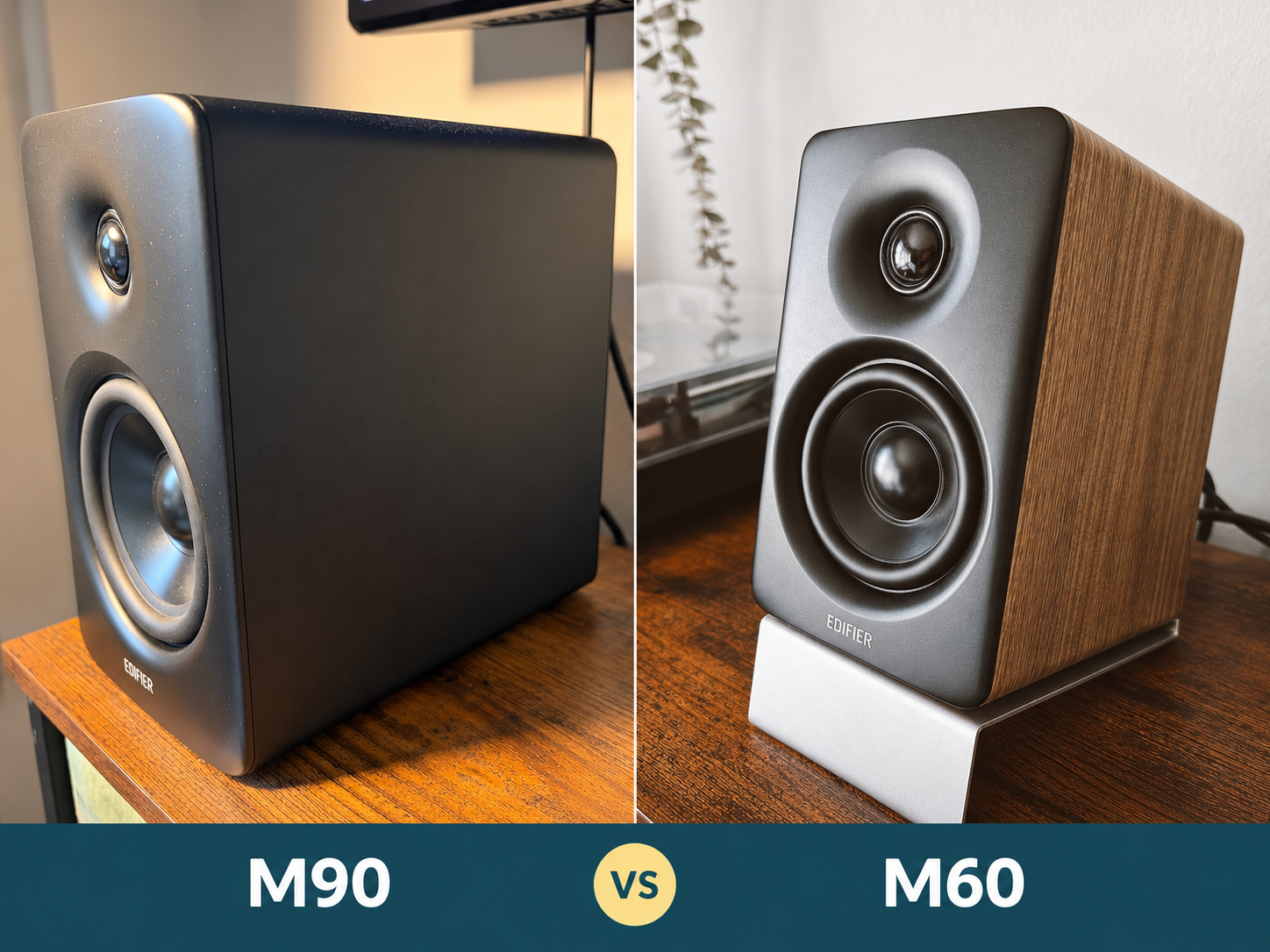
I’ve had the Edifier M60 for almost a year. They started out on my desk, one on either side of my M1 MacBook Air. They took up very little space, and I loved the sound I got from them over USB-C. After a while, I realised their size might make them an even better fit beside my Audio-Technica turntable. What struck me when I put on a record was the stereo separation. The singer sat right in the middle, and I could pick out the instruments around the voice. That’s a lovely sound to get from a vinyl setup this compact. That’s where I use them most now, although I occasionally pair my iPhone with them to stream music from Spotify.
Then Edifier sent me the M90. I liked the design as soon as I unpacked them, but the real surprise came when I started listening. I tried them with my MacBook, then with my Thinkya JA-310R CD player, before swapping them in for the M60 on my turntable. They could go considerably louder, but what I appreciated most was the extra weight in the bass. I could hear it on familiar records at my usual listening volume. I’d happily buy the M90 just for music.
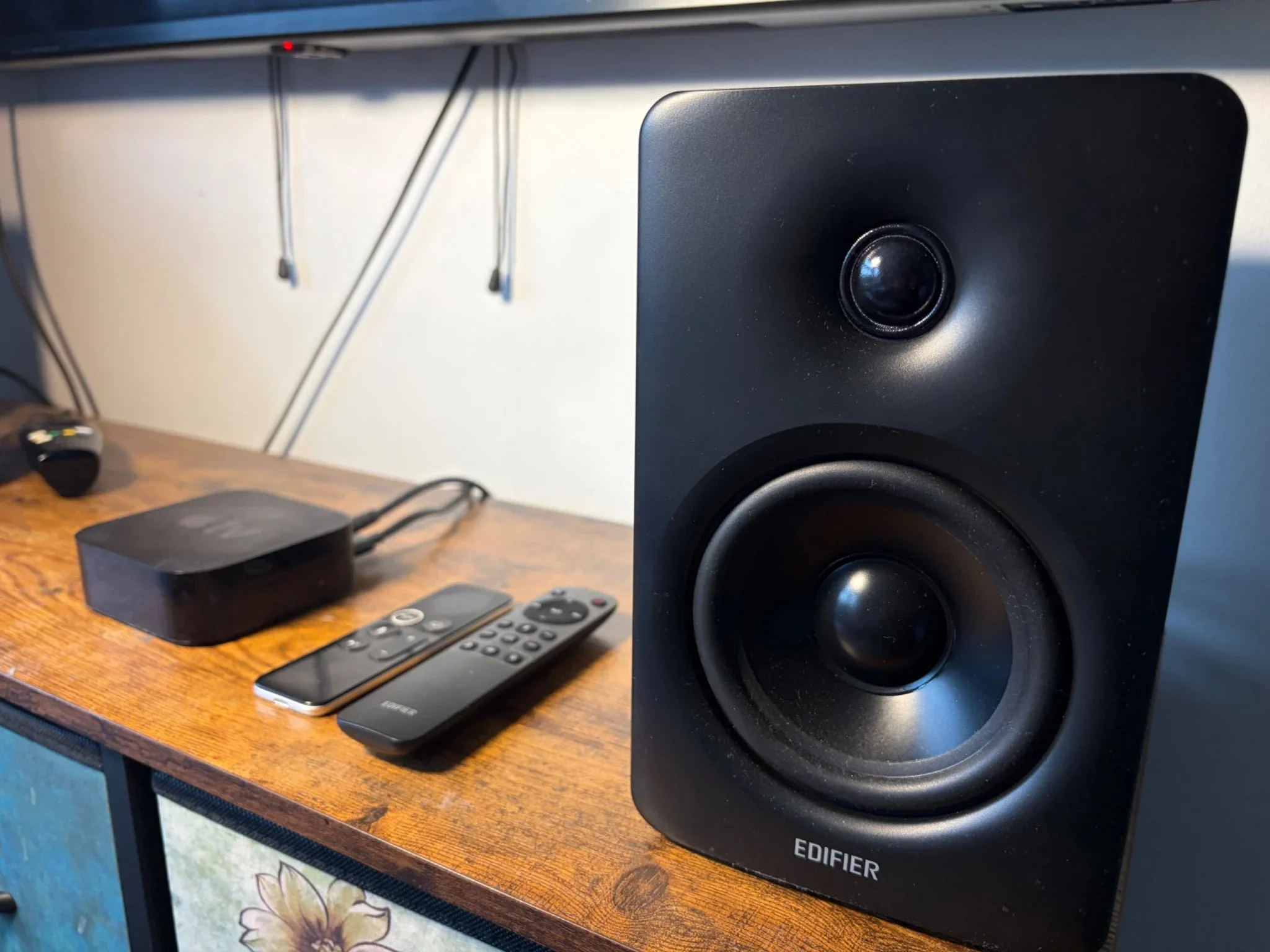
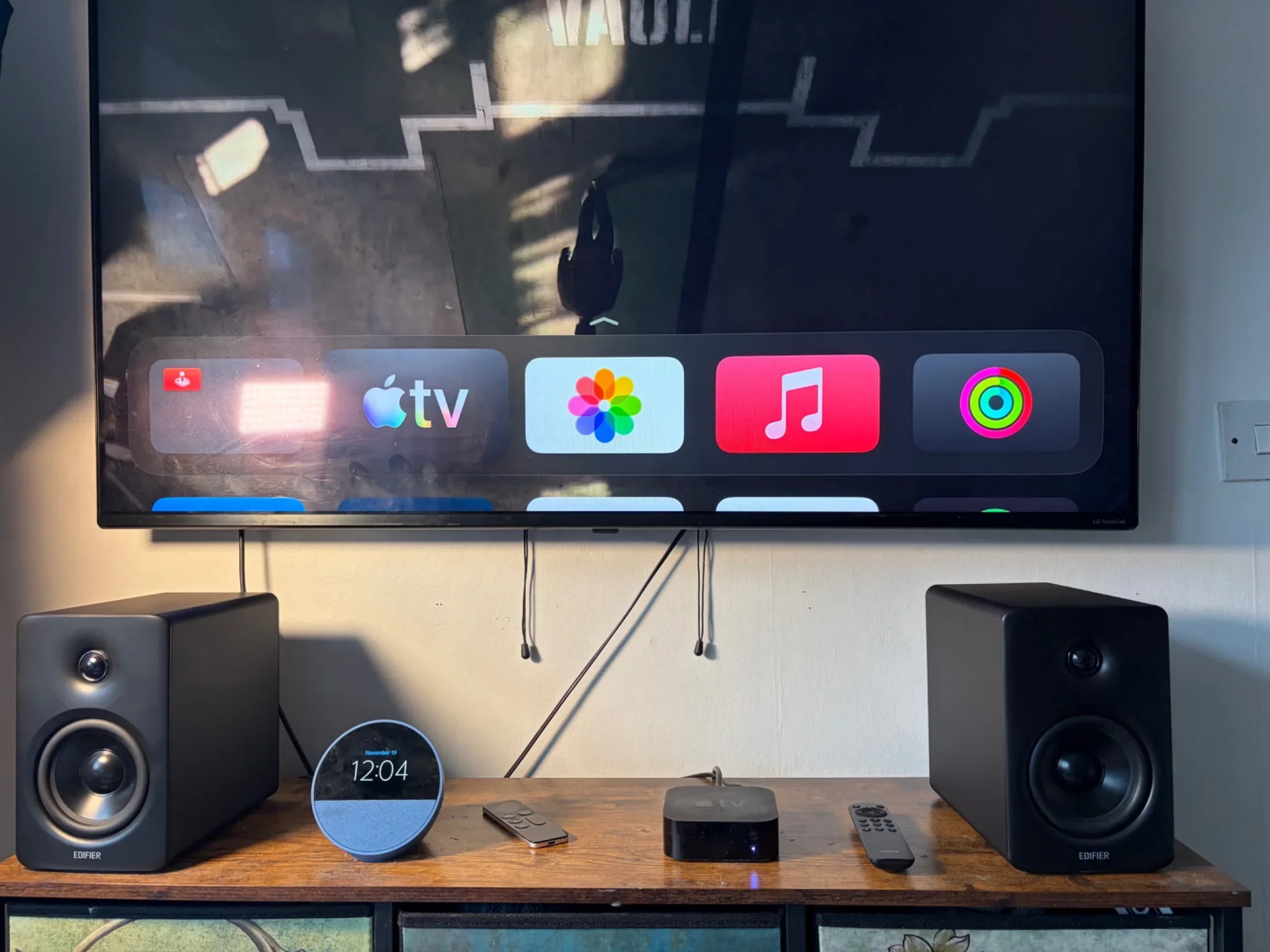
Their size decided where they ended up. The M60 fit my turntable cabinet better, so I took the M90 into the bedroom, placed one on either side of my LG 4K TV and paired them with my Apple TV 4K over Bluetooth. What a setup. I can settle down for a film or choose an album on Spotify, and quite often it’s the album that makes me switch the TV on.
So which pair would I buy? For a small desk or a compact turntable setup, I’d choose the M60. If I had room for either pair, I’d spend the extra on the M90.
Edifier M60 vs M90 at a glance
| Feature | Edifier M60 | Edifier M90 |
|---|---|---|
| My pick for | A small desk or a compact turntable setup | Music if you have the space, or one pair for both music and TV |
| Drivers per speaker | 3″ aluminium mid-bass driver and 1″ silk-dome tweeter | 4″ aluminium mid-bass driver and 1″ silk-dome tweeter |
| Amplifier power | 66W RMS total Mid-bass: 2 × 18W Treble: 2 × 15W |
100W RMS total Mid-bass: 2 × 35W Treble: 2 × 15W |
| Frequency response | 58Hz–40kHz | 50Hz–40kHz |
| Wired inputs | USB-C and 3.5mm AUX | HDMI eARC, optical, USB-C and 3.5mm AUX |
| Bluetooth and codecs | Bluetooth 5.3 SBC and LDAC |
Bluetooth 6.0 SBC and LDAC Optional multipoint |
| Hi-Res support | Hi-Res Audio and Hi-Res Audio Wireless certified. 24-bit/96kHz processing. | Hi-Res Audio and Hi-Res Audio Wireless certified. 24-bit/96kHz processing. |
| Subwoofer output | No | Yes |
| Size per speaker W × H × D |
100 × 168 × 147mm | Active: 133 × 212 × 225mm Passive: 133 × 212 × 210mm |
| Controls and app | Illuminated top touch panel and Edifier ConneX app. No physical remote. | Rear control knob, Edifier ConneX app and included 2.4GHz remote. |
| Finishes | Black, White, Classic Oak | Black, White |
Edifier M60
Check Price on Amazon Check Price on Amazon UKEdifier M90
Check Price on Amazon Check Price on Amazon UKDesign and build quality
If you’re measuring up at home, start with the depth. The active M90 is 33mm wider than an M60 but 78mm deeper. I could accommodate the extra width more easily than the extra depth on my turntable cabinet. A useful way to judge it is to lay a piece of paper measuring 133 × 225mm where the active M90 would sit. Then look at how much space you have left behind it for the plugs.
My M60 are the Classic Oak version. I particularly like that finish beside a record player. At just 10cm wide, each cabinet leaves a surprising amount of usable space on a desk. I also appreciate that Edifier includes the aluminium stands. They tilt the speakers upwards by 15 degrees, a sensible angle when the speakers are sitting below ear level on either side of a laptop.
The M90 feel more substantial, with solid MDF cabinets and enough weight that you notice the difference as soon as you handle them. I also appreciated the longer cable joining the two speakers. The M60 cable works well around a computer, but it can limit how far apart the speakers sit on a sideboard. With the M90, I had more freedom to place one on each side of the television.
One thing I would change on the M90 is the exposed tweeters. As a dad of four, I can see how tempting those little domes might look to a child. I’d have liked removable grilles, particularly on a pair of speakers that might spend years within reach on a family TV cabinet.
Sound quality
Bass at the volume I actually use
A kick drum has a satisfying punch through the M60. A bass guitar is easy to follow, and double bass has enough presence to make jazz particularly enjoyable. What these little speakers do well is give a recording some warmth while leaving space for the instruments around it. On a desk, that balance suits me very well.
With music that depends on really deep bass, I do start to hear the limits of those 3-inch drivers. Turning the M60 up helps them fill a small room, but it doesn’t give the lowest notes much more substance. If deep electronic bass is a big part of what you enjoy, that’s worth knowing before you buy them.
The M90 have a fuller sound even when I keep the volume comfortable. Spotify’s Indie Mix brought this out nicely. The bass carried more weight, yet I could still follow the words without any effort. The turntable made the difference easiest to judge because I knew those records through the M60. I enjoyed that same bass weight when I played CDs through the M90.
There’s a detail in the power figures that’s easy to overlook. Both models allocate 15 watts per side to the tweeters. The bigger change is in the mid-bass, where each M90 has 35 watts driving a 4-inch unit, compared with 18 watts and a 3-inch unit in the M60. For me, the benefit is being able to enjoy a fuller recording on an ordinary evening at home. I don’t need to play it loudly to appreciate where the extra money went.
Midrange, vocals and treble
Vocals remain my favourite thing about the M60. With a speaker on either side of my MacBook, a singer has a convincing position in the middle. On acoustic recordings, guitars and piano retain their individual character. There’s enough detail to reward paying attention, but the treble is comfortable enough that I can have music on quietly while I work for a long stretch.
That matters if you’re buying speakers mainly for a desk. A pair that sounds impressive for the length of one song can be a poor companion for an afternoon. The M60 have stayed enjoyable over almost a year of use, and the natural way they present voices is a large part of the reason.
The M90 keep that vocal clarity. On CD, I could enjoy the extra bass and still hear the singer clearly above it. Treble sounded clear, too. I wouldn’t suggest spending the extra money because you expect a dramatic change at the top end. What I enjoyed was the overall balance. Bass instruments had more substance while the voice held its place, and that quality carried over just as well to someone speaking on screen.
Stereo separation, quiet listening and volume
Well-recorded jazz is a good example of what the M60 can do with two small cabinets. Sitting between them, I can hear the singer in the centre and distinguish the instruments around the voice. If you’re moving from a single Bluetooth speaker on your desk, that spread of sound is one of the first things I’d listen for.
Low and medium volumes are where I think the M60 make the strongest case for themselves. They remain clear, I get plenty of detail, and I’m already close enough to enjoy the stereo image. They can play surprisingly loudly, but as I push them harder, the lower frequencies start to show the limits of the cabinet size. I wouldn’t buy them for parties or a large living room.
The M90 can go considerably louder. Around 50–60% on their volume control was already plenty for me. From my usual spot in bed, a voice was easy to follow between the speakers, and there was enough bass to give films and music some scale. I didn’t run either pair to a measured maximum. The difference that influenced my decision was how satisfying the M90 sounded from across the room at a level I’d actually use.

Connections and controls
USB-C would be my first choice with either pair on a desk. I connected them to my M1 MacBook Air, selected the speakers as the audio output and could get on with listening. It also leaves the analogue input free for a turntable or CD player. With the M90, I preferred the sound from my MacBook over USB-C to a standard Bluetooth connection from my iPhone. Those were different source devices, so I wouldn’t attribute the difference to the cable alone.
Both pairs support LDAC from a compatible device. An iPhone connects over ordinary Bluetooth, but it won’t transmit LDAC on its own. I tried a Questyle QCC Dongle Pro 2 with the M90 and could hear an improvement, although I was already happy with the standard wireless connection. There’s one setting worth knowing about on the M90: to use LDAC, turn off multipoint in the Edifier ConneX app, then enable LDAC. Multipoint lets you stay connected to two Bluetooth devices, so the choice depends on how you listen.
On the M60, the top touch panel lights up as my hand approaches. It’s responsive and convenient on a desk. Both pairs work with ConneX for sound adjustments, and I tend to leave the M60 on the Classic preset. The M90 add a simple plastic remote, which I appreciate much more when the speakers are across the room.
The M90 offer HDMI eARC and optical alongside USB-C and AUX. With HDMI eARC and CEC enabled on a compatible TV, you can use the TV remote for speaker power, mute and volume. If you’re setting that up, check that the television is sending stereo PCM. The M60 have neither HDMI nor optical. If your television only offers HDMI or optical for external sound, I’d choose the M90.
The M90 also have a dedicated subwoofer output. I haven’t tried them with a subwoofer, and in my bedroom I’m happy with their bass on its own. But if you think the speakers might eventually move into a bigger room, having that socket gives you a straightforward upgrade. The M60 don’t offer it.
Edifier M60
Check Price on Amazon Check Price on Amazon UKEdifier M90
Check Price on Amazon Check Price on Amazon UKAlmost a year with the M60, and why they’re beside my turntable
I’ve used the M60 with my MacBook, iPhone and Apple TV, but my Audio-Technica turntable is where they’ve settled. The deck has a built-in phono preamp, so I take its line-level output straight into the speakers’ 3.5mm AUX input. There’s no separate amplifier to find space for, and the whole setup fits comfortably on my cabinet.
What keeps me coming back to the M60 with records is how easy it is to follow individual musicians. On jazz and acoustic recordings, I can listen to the guitar, shift my attention to the piano, then come back to the singer. Double bass has a pleasing presence, especially given how little room the speakers take up.

Swapping in the M90 answered the obvious question. Yes, I preferred the fuller bass on my records. Given a broader cabinet and more room to position the speakers, I’d happily choose the M90 for vinyl. With my actual furniture, the M60 fit better, and I already enjoy what they do with the records I play most.
The small inconvenience I notice here is the lack of a physical remote. The M60 touch panel makes perfect sense beside a keyboard. Once I’ve put a record on and settled into a chair, I’d appreciate being able to adjust the volume without reaching for my phone or getting up. I go into the vinyl setup and my longer-term impressions in my full Edifier M60 review.
A month with the M90, from CDs to my bedroom Apple TV 4K
The Thinkya JA-310R and the M90 made one of my favourite combinations in this comparison. Through the M90’s AUX input, I got the weight I’d enjoyed with vinyl and that same clarity through the vocals. If you want a compact stereo for an existing CD player, I’d put the M90 ahead of the M60, provided you have the space.
In the bedroom, I have an LG 4K television and an Apple TV 4K. I paired the M90 directly with the Apple TV over Bluetooth. YouTube was a useful first test because somebody talking straight to camera makes a lip-sync problem easy to spot. From my usual position in bed, the voice matched the movement of the person’s mouth. I had the same experience with films on Netflix. I didn’t measure latency, so that observation applies to my setup.
We have a 70-inch OLED in the living room, yet the bedroom has become my favourite place to settle down for a film. Having a speaker on either side of the screen makes dialogue easy to place, and the bass gives a soundtrack enough weight for the room. I also tried the M90 with our Google TV Streamer in the living room and was just as happy with the sound there.
What gives the bedroom the edge for me is music. I enjoy browsing Spotify on the television, choosing an album with the Apple TV remote and settling back to listen. Sometimes the album is the reason I switch the screen on in the first place. The turntable and CD player had already convinced me how good the M90 are as stereo speakers. The bedroom happens to be where I can enjoy them most often. I cover those different setups in my full Edifier M90 review.
Desk, TV or music: where would I put each pair?
For a desk, I’d choose according to where I sit. I loved the M90 connected to my MacBook, but they felt a little too big on my desk, and sitting that close gave me the sense I was only getting part of what they could offer. The M60 fit neatly, their stands aim them towards me, and the volume controls are right under my hand. If the desk is also where you keep the speakers for the whole room, the M90 become a much stronger option.
For music, assuming both pairs fit, I’d buy the M90. That applies just as much to a turntable or CD player as it does to Spotify. The M60 already do voices and acoustic instruments beautifully. What the M90 add is a fuller foundation underneath them, and I enjoyed that across more than one source. You don’t need to own a television to get your money’s worth.
For a TV, I’d choose the M90 even though the M60 worked well with my Apple TV. Fuller sound from further away is part of it. The longer connecting cable, physical remote and choice of wired TV inputs also make them easier to live with once they’re in place.
Are the M90 worth the extra money?
The M60 are the more affordable pair. For me, the reason to spend extra on the M90 is the fuller bass I could hear at my usual listening volume. How much that matters depends on where you’ll use them
For a laptop and phone on a small desk, I’d save the money. The M60 already give you USB-C, LDAC support, adjustable sound and a good pair of angled stands. If you spend most of your time listening at arm’s length, those are things you’ll use. Paying more for an HDMI socket behind a computer monitor makes little sense unless you have another job in mind for the speakers.
If music is a proper sit-down pleasure for you and there’s room for the larger pair, I think the M90 justify the premium on sound quality. I could hear the improvement with familiar records, and I enjoyed it just as much on CD. The remote, TV connections and subwoofer output add value, but I’d still rate them highly without ever putting them beside a screen.
Existing M60 owners have a slightly different decision. I’d upgrade if you regularly wish bass guitar had more body, listen from further away than you used to, or need a connection the M60 don’t have. If they’re already doing a lovely job on your desk, I’d keep them.
Who should skip both?
Skip both if your system needs balanced studio inputs, rear-channel surround sound, or a direct connection from a phono-only turntable with no separate preamp. I’d also look at a larger system if your main requirement is very deep electronic bass at high volume and you have no intention of adding a subwoofer.
Frequently asked questions
Can I connect a turntable directly to either pair?
Yes, if your turntable has a line-level output. If your deck has a built-in phono preamp and a PHONO/LINE switch, select LINE and connect to AUX. A turntable with only a phono output needs an external phono preamp before either pair of speakers.
Can I add a subwoofer later?
The M90 have a dedicated subwoofer output. The M60 don’t. If a subwoofer is already part of your plan, I’d choose the M90 from the start.
Do the M60 or M90 work with an iPhone?
Both work over ordinary Bluetooth. An iPhone doesn’t send LDAC on its own, so you’d need a compatible external transmitter for that codec. I was already happy with the M90 over standard Bluetooth, so I’d try them that way before spending money on an accessory.
Edifier M60
Check Price on Amazon Check Price on Amazon UKEdifier M90
Check Price on Amazon Check Price on Amazon UKFinal verdict
The M90 are the pair I’d buy for sound quality. My favourite test was putting them on the Audio-Technica, where I knew the sound of the M60 well enough to recognise what changed. I heard more weight in my records without losing the vocals I’d always liked. Hearing the same qualities through a little CD player would have been enough for me to recommend them, even if I’d never tried the Apple TV.
The M60 are the pair I’d buy for my desk, and the pair I’ve kept beside my turntable. They fit the cabinet, they make jazz a pleasure at the volume I enjoy, and after almost a year I still look forward to listening to them. If your space looks like mine, buy the M60 with confidence. If both pairs fit comfortably and your budget allows it, I’d spend the extra on the M90.
Jerome
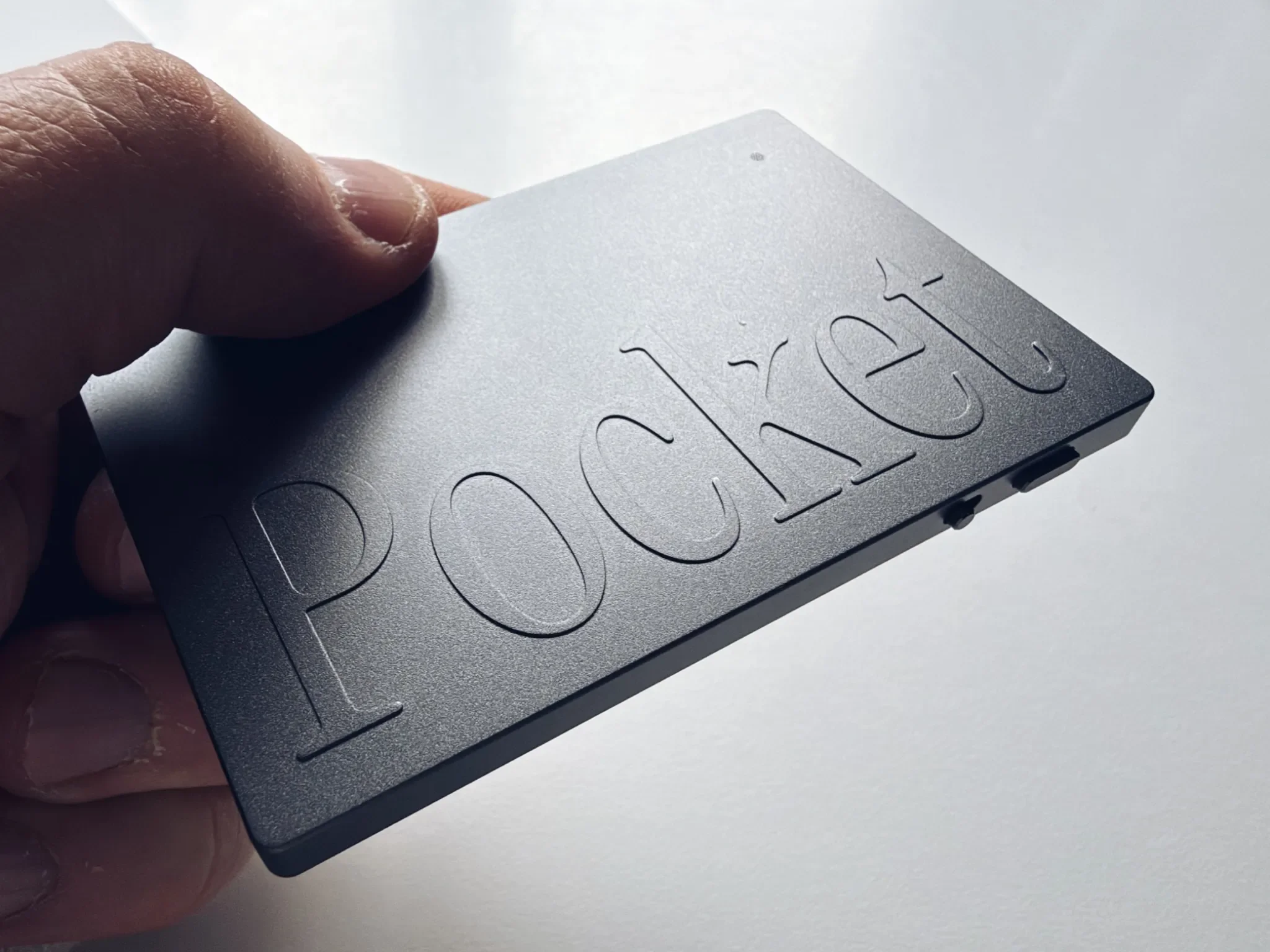
I’ve tested the Edifier M60 and M90 with vinyl, CDs, a MacBook and Apple TV. Here’s where the M90 sound better and why I still use the M60.