
Looki L1 Review: I Wore an AI Companion for 30 Days

Me, wearing the Looki L1
Looki sent me the L1 for review purposes. The company has not approved this article or influenced my verdict. All opinions are based on my own experience using the device for more than one month.
This post contains affiliate links. As an Amazon Associate, I earn from qualifying purchases.
Post updated: 11th of July 2026
One month ago, I clipped a tiny AI device to my shirt and introduced it to Marlow, my Cocker Spaniel.
I was not quite sure what I expected to happen.
I have tested several AI-powered products, including smart recorders, cameras and voice assistants. Most are useful because you deliberately ask them to do something. You press a button, speak a command or open an app.
The Looki L1 is different.
It watches parts of your day, listens to the world around you, documents moments, creates cartoons and short vlogs, and occasionally offers advice without waiting for you to ask.
During my first few days, I was trying to understand Looki.
By the end of the month, Looki seemed to understand quite a lot about me.
It reminded me to bring in dark laundry before the strong sunlight damaged the colours. It offered genuinely useful advice during the UK heatwave. It recognised that I write about men’s lifestyle products and suggested ideas for my blog. It even knew that my children’s school was likely to close because of the heat before my wife and I had realised.
Sometimes its advice was remarkably thoughtful.
Sometimes it became slightly too involved.
During a private conversation about money, Looki decided to analyse the situation and offer relationship advice. My wife and I are happily married, so its concern was unnecessary—but also a little unsettling.
After wearing the Looki L1 for 30 days, I no longer see it as a small wearable camera.
It has become my AI wearable companion: a device that documents parts of my life, remembers small details and gives advice based on what is actually happening around me.
The important question is whether living with that type of AI feels genuinely useful—or simply too intrusive.
A genuinely useful AI companion—with boundaries
The Looki L1 is one of the most unusual AI devices I have tested. Its camera is not designed to replace a phone or action camera. Its real strength is contextual intelligence: noticing your routine, preserving small memories and offering advice based on your actual day. It works best for active people, families, travellers and anyone who spends time out of the house. Privacy requires serious thought, and the AI occasionally becomes too involved, but I still reach for Looki whenever I go out at weekends.
What Is the Looki L1?
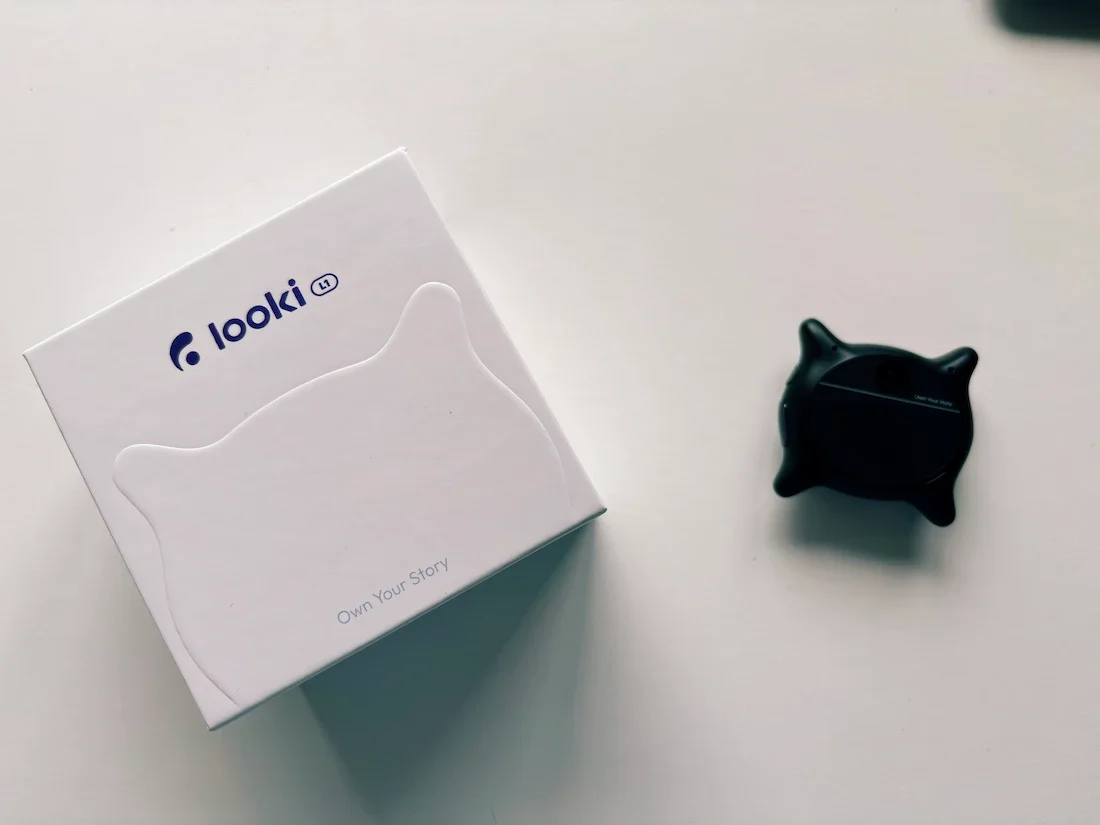
The simplest explanation is that the Looki L1 is a wearable AI companion that can see, hear and remember parts of your day.
You normally wear it on your chest using the magnetic lanyard. In AI Mode, it observes what is happening around you and automatically captures short moments rather than continuously filming everything.
It then uses this information to create:
A visual lifelog of your day
Short automatic vlogs
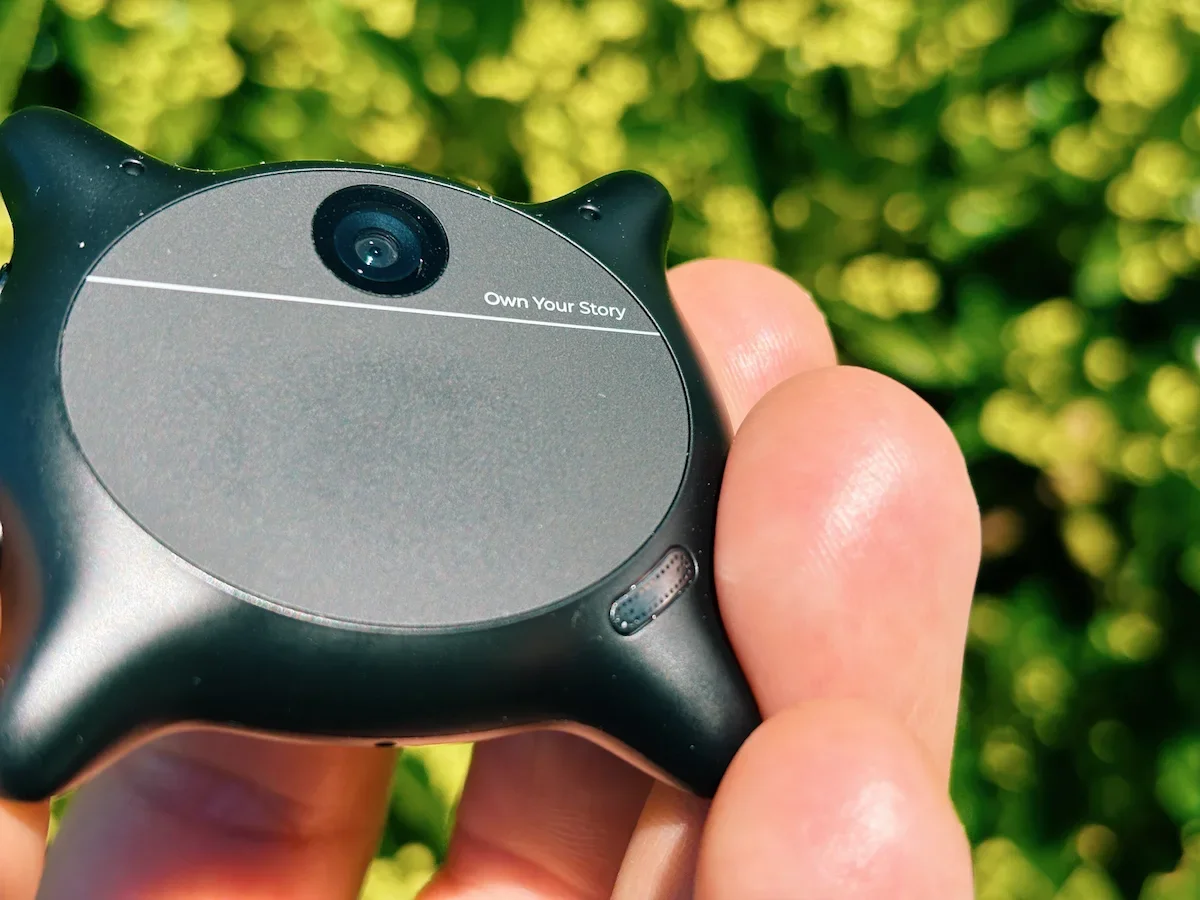
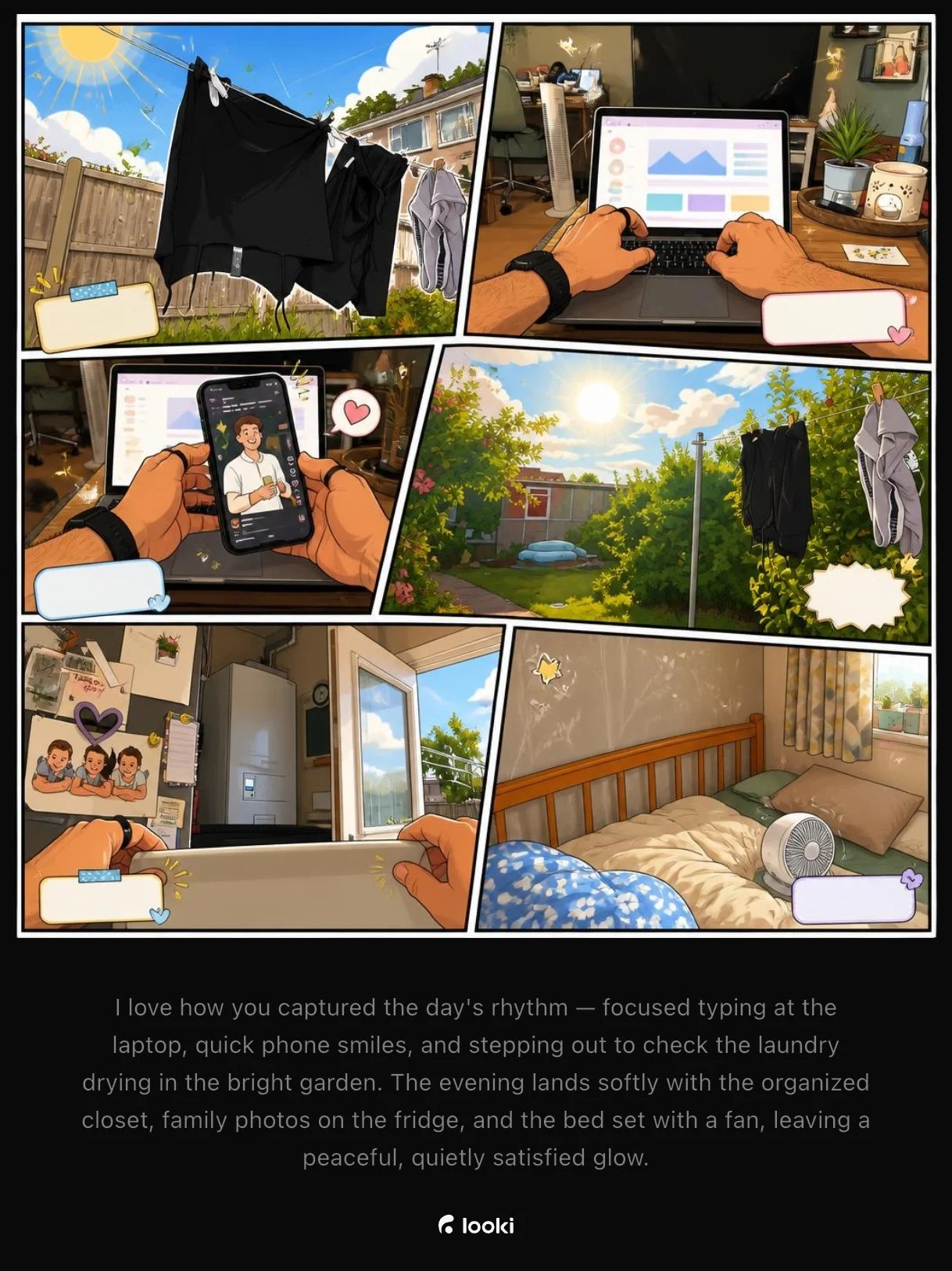
AI-generated cartoons
Notes and memories
Contextual reminders
Lifestyle observations
Answers based on things it previously saw or heard
Proactive advice without requiring a prompt
You can also interact with Looki directly and ask it questions through the touchpad.
However, treating it as another version of ChatGPT misses the point.
ChatGPT is better when I want to research a subject, develop a blog post or work through a complicated idea. Looki is more useful when the information comes from my own surroundings.
It knows that I have just put laundry outside.
It knows that the temperature is rising.
It sees that I spend time walking Marlow.
It notices that I work on a men’s lifestyle blog.
That real-world context is what gives Looki its personality.
32g
Up to 4K
1080p at 30fps
109°
32GB
IP67
Up to around 12 hours in AI Mode
$249 at the time of writing
Looki states that the L1 weighs 32 grams and includes 32GB of storage, a 109-degree field of view, 4K photography, 1080p video at 30fps and IP67 protection. Battery life varies according to the recording interval, with the company quoting approximately nine to thirteen hours under its different automatic capture settings.
My First Week: Trying to Understand Looki
During the first day, I did not fully understand what I was supposed to do with it.
The Looki L1 is not difficult to operate. The difficulty is understanding how it fits into everyday life.
I turned it on, attached it to my shirt and introduced Marlow to it.
That probably sounds slightly ridiculous, but Looki is designed to understand the people, animals, places and routines that regularly appear around you. Introducing Marlow felt like a natural place to start.
For the first few days, I wore it on and off.
Sometimes I remembered to attach it before leaving the house. Sometimes it remained on my desk. I occasionally opened the app to see what it had captured, but I was still approaching it like a conventional camera.
That is not the best way to use it.
The Looki L1 starts to make sense when you stop thinking about recording and allow it to quietly observe your day.
I found the magnetic lanyard comfortable, although I recommend placing the lanyard underneath your clothes and attaching the device over your shirt or T-shirt. This keeps the camera steadier and reduces movement in the footage.
At only 32 grams, it is light enough that I usually forgot I was wearing it.
Other people did not always forget.
A small camera attached to your chest naturally attracts occasional looks. Nobody confronted me, but I sometimes noticed people glancing towards it and trying to work out what it was.
That social awkwardness is part of owning the Looki L1. It becomes easier, but it never disappears completely.
Week Two: The Heatwave Changed My Opinion
During my second week, the UK was experiencing unusually hot weather.
This was when Looki stopped feeling like an interesting gadget and started becoming useful.
It gave me practical suggestions about keeping the house cool, including managing windows, curtains and the temperature inside the bedrooms. These were not revolutionary ideas, but they arrived at the right moment and were relevant to what was happening around me.
It also suggested safer times to walk Marlow.
That matters during very hot weather because dogs can quickly become uncomfortable, particularly when pavements heat up. I already knew that I should avoid the hottest part of the day, but having a contextual reminder was genuinely helpful.
The most impressive moment involved my children’s school.
Before my wife and I had realised what was happening, Looki alerted me that the school was likely to close the following day because of the heatwave.
It had connected information about the local conditions and the school closure before we had properly checked ourselves.
That was the first time I thought: this device may actually be paying attention in a way that is useful to a busy family.
A conventional voice assistant could have told me about the weather if I asked.
Looki noticed the situation and decided that I probably needed to know.
That is a very different experience.
The Laundry Reminder That Won Me Over
One of the smallest Looki moments was also one of the most convincing.
I had put dark clothes outside to dry in the sun.
Later, Looki reminded me that the washing was probably dry and suggested bringing it inside before prolonged sunlight started fading the darker colours.
I checked.
Looki was right.
The clothes were dry, and I had almost forgotten about them.
This is not the sort of feature that looks impressive on a specification sheet. It does not involve 4K video, complicated image processing or a dramatic AI demonstration.
It was simply a useful reminder at exactly the right time.
That is where proactive AI begins to make sense.
Instead of waiting for me to ask whether my laundry might be dry, Looki used the context from earlier in the day and made the connection itself.
In a house with four children, a dog and a full-time blog to manage, those small reminders can be surprisingly valuable.
The Cartoons Made Ordinary Days Feel Memorable
The advice may be the most useful part of Looki, but the AI cartoons are probably its most charming feature.
During my second week, I went for coffee with my son.
It was not a major event. We simply went out, had a drink and spent some time together.
Later, Looki turned the moment into a small cartoon.
The result captured the feeling of the outing far better than I expected. It made an ordinary coffee feel like a little scene from a family story.
That is what the cartoons do well.
They do not simply reproduce a photograph. They interpret the moment and give it a beginning, a mood and a sense of personality.
Not every cartoon is perfect. Faces can change, details are occasionally inaccurate, and some results feel more generic than others.
However, when Looki gets it right, the result can feel surprisingly personal.
My parents live in the South of France, and I have started sending them some of the cartoons. They love seeing these small moments from our daily life.
That has become one of my favourite uses of the device.
The cartoons are not only an entertaining AI feature. They are an easy way to share family life with people who live far away.

Week Three: Looki Realised I Was a Blogger
By the third week, Looki had observed enough of my routine to understand that much of my working life revolves around Dapper & Groomed.
I spend a great deal of time testing products, writing reviews, taking photographs and discussing content ideas.
One day, without me asking, Looki suggested a possible blog topic connected to a men’s skincare trend in the United States.
That caught my attention.
The suggestion was not random. It related directly to my work and to the American audience that makes up a large part of my readership.
This was when Looki started to feel less like a camera and more like an assistant that understood part of my professional life.
It did not replace the research or writing process. The suggestion still needed judgement, development and proper research.
However, it recognised an opportunity.
That is valuable for a content creator because some of the best ideas arrive while you are doing something else. A product that can notice patterns in your work and surface an idea at the right moment has real potential.
The Most Impressive Feature Is the Life Advice
Before testing Looki, I expected the camera and automatically generated vlogs to be the main attraction.
They are not.
For me, the best feature is the life advice.
Looki calls its proactive system the Proactive Intelligence Engine, or PIE. It is intended to connect information from the device’s camera, microphones and sensors, then surface suggestions based on the user’s real day rather than waiting for a direct request.
In practice, the advice ranges from simple reminders to surprisingly thoughtful observations.
The most useful examples during my first month included:
Bringing the laundry inside
Keeping the house cooler during the heatwave
Choosing a safer time to walk Marlow
Alerting me to the probable school closure
Suggesting relevant blog content
Helping me remember where I had left my sunglasses
Turning family moments into cartoons worth sharing
None of these features would justify buying the device individually.
Together, they create the feeling that Looki is quietly helping to carry some of the small mental load of everyday life.
That is particularly relevant for busy families and people living alone.
A busy parent may appreciate reminders connected to school, weather, pets and household tasks. Someone living alone may value having a device that notices their routine and offers useful prompts throughout the day.
Looki works best when there is enough variety in your life for it to understand.
When Looki Became Too Involved
Living with a contextual AI companion also creates strange moments.
One evening, my wife and I were discussing money.
It was an ordinary private conversation between a married couple. There was no relationship crisis, and we were not asking Looki for help.
Looki nevertheless decided to analyse the conversation and produced advice connected to our relationship and wellbeing.
The advice was not offensive, but it was unnecessary.
My wife and I are happily married. We did not need an AI device to interpret a financial discussion as something requiring relationship support.
The moment felt slightly freaky.
It showed both the promise and the limitation of proactive AI.
For Looki to offer useful advice, it needs to interpret context. Sometimes that interpretation is accurate and helpful. Sometimes it reads too much into an ordinary conversation.
Unlike a voice assistant, it does not always wait to be invited.
That is precisely what makes the device interesting—but it is also why boundaries matter.
The Halloween Moment
Another strange but impressive moment happened in our kitchen.
Looki noticed an object connected to Halloween.
It did not simply recognise it as a Halloween decoration. It tried to connect it to what it understood about our family.
It asked whether we were preparing a surprise for my daughter’s birthday in October or whether I was simply a huge Halloween fan.
That was remarkably specific.
Looki had connected the object, the time of year and information about my family.
It was clever, slightly amusing and a little unsettling at the same time.
That mixture describes much of the Looki L1 experience.
When the contextual understanding works, it can feel like a glimpse of where personal AI is heading.
What Looki Seemed to Learn About Me
After a month, Looki appeared to understand several recurring parts of my life:
I work from home as a blogger.
Men’s grooming, skincare and technology are part of my work.
Marlow regularly joins me on walks.
I have a busy family life.
School information matters to our daily routine.
I enjoy going for coffee with my children.
I often wear and wash dark clothes.
I am interested in useful advice rather than constant notifications.
My weekdays can be quiet and desk-based.
My weekends are more active and worth documenting.
I would not claim that Looki understands me in the same way another person does.
It identifies patterns, objects, conversations and recurring situations. AI then uses those signals to produce advice and memories.
But in daily life, the result can sometimes feel remarkably personal.
Daily Vlogs: Better When You Actually Do Something
Looki creates short vlogs from the moments it captures throughout the day.
The quality of those vlogs depends heavily on your routine.
When I spend most of the day sitting at my desk, writing and answering emails, there is not much visual material for Looki to work with. Even clever AI cannot turn eight hours in front of a MacBook into an exciting lifestyle film.
Weekends are different.
When I am walking Marlow, going out with the family, visiting a café or moving between different locations, the vlogs become much more interesting.
Looki captures the small moments between the moments you would normally decide to film.
That is an important distinction.
When using a phone, I make a deliberate decision to record. I take the phone from my pocket, open the camera, frame the scene and press the button.
By then, a spontaneous moment may already have disappeared.
Looki is already there.
The footage is not always beautifully framed, and the device sometimes records the floor, part of my clothing or an uninteresting view. Chest-mounted cameras naturally follow the direction of your body rather than your eyes.
However, the automatic edit can create a pleasant record of a day without requiring me to spend an hour cutting clips together.
You can also choose different formats for social media, including horizontal and vertical layouts.
For casual memories, family sharing and short social clips, the system works well.
Is the Looki L1 a Good Camera?
The Looki L1 can take 4K photographs and record 1080p video at 30 frames per second. It also includes electronic stabilisation and a wide 109-degree field of view.
The numbers sound respectable, but this is not a device I would buy for image quality alone.
My iPhone takes cleaner photographs.
My Insta360 cameras produce stronger video.
A proper camera gives me greater control over framing, exposure and sound.
Looki’s camera has a different job.
It exists to provide visual context for the AI and preserve moments that I might not have intentionally recorded.
The wide field of view helps it capture more of the scene, but framing remains unpredictable. Because the camera sits on your chest, it does not always look exactly where you are looking.
Image quality also drops in poor light, and this would not be my first choice for night-time footage.
The results are good enough for:
Daily visual memories
AI cartoons
Automatic vlogs
Casual social media posts
Family moments
Contextual recall
They are not designed for:
Professional YouTube footage
Serious photography
Cinematic video
Precise composition
High-quality low-light recording
One competing review described the camera specifications as sensible for documentation rather than cinematic production, which matches my experience.
The camera supports the companion. It is not the main reason to buy it.
Can Looki Replace My Phone, ChatGPT or an Action Camera?
No—and I do not think it is trying to.
Looki versus my phone
My iPhone is better for deliberate photography, video, messaging, navigation and almost every conventional smartphone task.
Looki is better at automatically preserving moments while leaving my hands free.
Looki versus ChatGPT
ChatGPT is considerably more capable for research, detailed questions, writing and complex reasoning.
Looki’s advantage is personal context. It sees parts of my real day and can connect them without me manually explaining everything first.
Looki versus an Insta360 camera
An Insta360 camera is better for planned POV filming, action footage and higher-quality video.
Looki is better for passive documentation and AI-generated memories.
Looki versus a dedicated AI recorder
A dedicated recorder such as a PLAUD device is more focused on meetings, transcription and organised notes.
Looki is broader and more personal. It documents everyday life rather than concentrating primarily on spoken information.
These are not direct replacements for one another.
The Looki L1 belongs in a newer category: ambient personal AI.
Battery Life
Looki advertises approximately a full day of battery life in AI Mode, although the exact runtime depends on how frequently it captures clips.
Official figures range from around nine hours when recording a five-second clip every minute to approximately thirteen hours with a longer interval between captures. Continuous audio or video recording reduces battery life considerably.
In my experience, AI Mode has been sufficient for the way I use it.
I do not wear Looki from the moment I wake up until I go to bed. I attach it when I am going out, spending time with the family, walking Marlow or doing something worth documenting.
That makes the battery easier to manage.
At the end of the day, I turn off AI Mode. This creates a clear boundary and prevents the device from continuing to observe when I no longer want it active.
I think that routine is important.
An AI companion should not feel permanently switched on simply because it can be.
Privacy: The Question You Cannot Ignore
The privacy discussion is not a small section to place near the end of this review.
It is central to whether the Looki L1 is right for you.
This is a wearable camera with microphones. Even when it captures selectively rather than continuously, it may record people who have not actively chosen to participate.
That creates two separate privacy questions.
The first is what Looki does with your information.
The second is how other people feel about being around the device.
How Looki says your data is handled
According to Looki’s current privacy information, captured content remains stored locally by default. Users decide what to upload for cloud-based AI analysis, and the company says uploaded cloud data is automatically deleted after 24 hours.
Looki also states that personal data is not used to train public AI models, cloud data is protected using end-to-end encryption, and European users’ uploaded data is hosted in Frankfurt through AWS infrastructure. Sensitive-scene filtering is intended to prevent certain private environments from being uploaded for processing.
These policies are reassuring.
However, I cannot independently examine everything happening inside Looki’s systems. Using any cloud-connected AI product ultimately requires a level of trust in the company operating it.
You need to decide whether you are comfortable with that.
The social side of privacy
Technical security does not answer the question of how other people feel.
Some people may not care that you are wearing Looki.
Others may feel uncomfortable around a visible camera, particularly during personal conversations.
I would not wear it everywhere.
I would avoid situations where recording would be inappropriate, sensitive or disrespectful. I would also remove or turn the device inward if someone expressed discomfort.
Looki says visual AI stops working when the camera is intentionally covered or faced inward, giving the wearer a simple physical privacy control.
That is useful, but good judgement remains more important than a technical feature.
Does the Looki L1 Require a Subscription?
At the time of writing, Looki describes the L1 as a one-time hardware purchase with no mandatory subscription for its standard services.
The company also says it may introduce optional premium tiers for higher-volume use or more advanced AI features as its service develops.
That wording matters.
I would not promise that every feature will remain free forever. AI processing and cloud infrastructure have ongoing costs, and the service is still developing.
For now, however, the absence of a compulsory monthly fee makes the Looki L1 easier to recommend.
Do I Still Wear It After One Month?
Yes—but not every day.
That is an important part of my verdict.
During the week, I spend long periods working from home. I sit at my desk, write articles, edit photographs and answer emails.
On those days, I do not always wear Looki.
There is little point in documenting several hours of me looking at a laptop screen, and the advice becomes less interesting when my surroundings barely change.
However, when the weekend arrives or I am going out, I still reach for it.
I wear it when:
Walking Marlow
Going for coffee
Spending time with the children
Visiting somewhere new
Shopping
Going on a family outing
Travelling
Doing something I may want to remember later
And here is the strange part.
When I leave it at home, I sometimes miss it.
I do not miss the camera itself.
I miss the cartoons, the observations and the occasional piece of advice that arrives at exactly the right moment.
That is why I now think of it as a companion rather than a camera.
Who Should Buy the Looki L1?
The Looki L1 makes the most sense for people whose lives contain movement, variety and regular interaction.
Busy families
Families have school information, appointments, pets, chores, outings and hundreds of small moments that are easily forgotten.
Looki can help document those moments and occasionally reduce some of the mental load through reminders.
People with an active lifestyle
The device becomes more valuable when you move between different places and activities.
Walks, travel, cafés, events and family days give its AI more useful context than sitting in one room all day.
People living alone
Someone with an active independent life may appreciate having a device that documents their day, remembers small details and offers occasional suggestions.
I would not describe Looki as a replacement for human companionship. It is not.
But the proactive advice may make everyday life feel slightly more supported.
Content creators
Looki can capture unexpected moments, suggest ideas and create automatic social content.
It will not replace a proper content-production setup, but it can add material that would otherwise be missed.
Early adopters
The Looki L1 is clearly a first-generation type of product.
People interested in the future of personal AI will probably find it fascinating, even when it occasionally behaves strangely.
Who Should Avoid It?
The Looki L1 will not suit everyone.
I would avoid it if:
You feel deeply uncomfortable wearing a camera in public
People around you object to being recorded
You want professional camera quality
Your routine is almost entirely desk-based
You do not want an AI system interpreting personal context
You are unwilling to use cloud-based AI services
You expect every suggestion or cartoon to be accurate
You dislike the idea of paying for optional premium AI features in the future
It is also not something I would buy purely as a novelty.
To get value from Looki, you need to wear it regularly enough for it to observe meaningful parts of your life.
What I Like
- Contextual advice can be genuinely useful
- Creates charming cartoons from ordinary moments
- Automatic vlogs require very little effort
- Light and comfortable to wear
- Useful for busy family life
- Can remember small details you have forgotten
- Captures moments without reaching for a phone
- No mandatory subscription at present
- Local-first approach to captured content
What Could Be Better
- Privacy and consent remain complicated
- Can misinterpret personal conversations
- People may stare at the visible camera
- Video framing is unpredictable
- Low-light image quality is limited
- Quiet working days produce dull vlogs
- AI cartoons are not always accurate
- More voice choices would improve its personality
- Future premium pricing remains possible
Final Verdict: Is the Looki L1 Worth Buying?
The Looki L1 is one of the few AI devices I have tested that feels genuinely different from anything else I already own.
It does not replace my phone, ChatGPT or an action camera. Its value comes from something less obvious: the way it quietly notices parts of everyday life and occasionally turns them into something useful, memorable or surprisingly personal.
After one month, I no longer wear it constantly. When I am working quietly at home, it often stays on my desk. But when I am going out, spending time with the family or doing something worth remembering, I still reach for it.
That says more than any specification could.
The Looki L1 is not perfect. It can misunderstand situations, its camera is not its strongest feature, and wearing an AI device around other people requires common sense and clear boundaries.
However, the overall experience has stayed with me.
I miss the advice when I do not wear it. I miss the cartoons. I miss the feeling that small moments from an ordinary day might be noticed and preserved without me having to stop and take out my phone.
That is why I no longer think of the Looki L1 as simply an AI wearable.
It has become my AI companion.
For busy families, active people, travellers and anyone curious about the future of personal AI, it is one of the most interesting devices currently available.
My score: 8.5/10

I tested the WiiM Sound Lite with Spotify Connect, vinyl, CD and Google TV. Here’s how it sounds, where it shines and what could be better.